About The Boy


Tom Duckett sheltered from the rain in the farmhouse doorway, a rubberised mackintosh round his shoulders, hunched over as he tried to keep his pipe alight. Soon there would be a short European twilight, but still visible ahead of him  now was a landscape unrecognisable as farmland: all dips and hollows, mud pools, the odd broken tree or shattered hedgerow, and, in places, unidentifiable lumps.

It was a fair distance to the place they still called Hill 60, though it no longer had the advantages of height; the mines and the long range batteries had seen to that.

Gunner Duckett knew the call would soon come to get back to their guns and take aim on the invisible. The ears, still retaining the noise of last night’s bombardment, would register the tinnitus of nonstop explosion, the spotters would signal from above, while his battery adjusted the range and tried to hit the German planes as they approached with their noisy mechanicals.

This Passchendaele was a place where dreaming of tomorrow could seem pointless, if not foolhardy, yet looking back at friends lost, and terror revisited, was even less  attractive.

He was a man more practical than imaginative, yet it was hard not to think of Rose and those two little girls at home, to wonder at the possibility one day of walking in Newsham Park with them, sticks thrown for the dog, a moment where he looked down and she looked up and their eyes exchanged happiness.

And maybe, one day,  a boy to complete the family. Saturday afternoons with him watching Everton, taking home fish and chips for the girls.

Was that not what they were fighting for? Surely there had to be some reason?

Tom was my grandfather and had joined the Royal Garrison Artillery with his cousin, Jim Donovan. They were like brothers, the same age, and since his father’s death when he was ten, Tom and his mother  had lived with the Donovans.

Initially deployed on coastal defences, they later  ended up on the Western Front. Gunner Duckett would be lucky and return home in January 1919, Corporal  Donovan would fall in France, just five weeks before the Armistice.

However,  Tom would be heartened with the birth of a son, Thomas, on January 29th 1920. He was a no nonsense Lancastrian and would have welcomed a boy into a household of females.

But young Thomas, or “The Boy” as he was forever known in our family, died, at less than a year old, at Christmastime in 1920, and Tom, Rose, and the two girls had to bear that sad loss.

(When the second world war commenced in September 1939, Tom and Rose’s first thoughts were relief, because, had he lived, The Boy would have been among the first to be called up.)

However, a few years after their loss, in 1928, there was some joy to be had from Everton’s performances. Going into the last game of the season they were  league champions, and now all attention was focused on their phenomenal leading goal scorer, Dixie Dean. Three goals against Arsenal in the final game of the season would take his total to 60 league goals for the season in 39 appearances, a new record, which still stands.

Tom Duckett was understandably excited  by the prospect, but could not suppress the thought  that he should have had an eight year old son with whom to share the experience, not to mention his cousin, Jim. After all, half the delight  in reminiscing is having someone with whom you can relive the experience.

Maybe he could take one of the girls?

This was something of a revolutionary idea. Contemporary football  crowds would be overwhelmingly male and  working class  and not considered suitable for the “fair sex”.

The older girl, now thirteen, took after her father – outgoing and confident – but she was increasingly interested in clothes and dancing and he couldn’t see her wanting to go to the match.

However, the eleven year old, quieter and closer to her mother, might enjoy the opportunity to spend time with her dad, and so he suggested the outing, and she said yes. 

He felt self-conscious  as they headed up the hill from Kensington to Goodison Park but the excitement  of the occasion soon outweighed any embarrassment.

Which is how my mother was in an attendance of over 48000 who saw a 3-3 draw, the record achieved by a powerful Dean header from a corner just eight minutes from time. The crowd predictably went wild and then the championship trophy was awarded after the game.

Though my mother retained a love of sport throughout her life, that was the only football match she ever attended – but she was still speaking  about it sixty years later. And Tom Duckett had a pal with whom he could reminisce.

Goodison Park has seen its last first team game before Everton move to their new stadium at Bramley Moore Dock. It seemed important to me to visit one more time and to share the experience with my son and also my oldest school friend.

So why was I keen to visit Goodison?

I am a Hibernian fan, born in Edinburgh and following the tradition of my father’s family. In my teens, I lived around twenty miles from Goodison, but chose to follow local team, Southport, in the third and fourth division. So, while retaining a soft spot for the Blues, I can’t claim to be a supporter.

In addition, like most stadiums, though not to the same extent as many, Goodison Park has changed since the 1920s – I doubt my grandfather would recognise it, though elements of the original Leitch main stand remain, and Goodison was always a four sided ground.

It’s not fundamentally, then,  an attempt to stand in my ancestors’ footprints. Football, like the society in which it exists has changed so dramatically that it would be foolish to suggest I could recapture anything of their experiences.

What I am celebrating, I suppose, is something to do with relationships which might otherwise be impossible to capture.

It is all about connection.

When I stood in that main stand looking down on the pitch, I was thinking of my mother’s childhood, her relationship with her father, and how the loss of a baby child can affect a family dynamic.  There was a nod also to the fourteen year old me, attending three World Cup games here, seeing Pele, Garrincha, Eusebio in a world of football long disappeared.

The past, of course, is a foreign country – but what we bring back from our wistful visits there can be important – a kind of emotional duty free.

Though my grandad died when I was five, I can remember him, and, as it is for most of us, my relationship with my mother is a lot easier to quantify now than it was when she was alive.

Visiting Goodison Park gave me a locus for understanding the relationship between my mother and her father; it gave me a space to focus on the uncle I never knew, and how his loss would always affect the family. I will never know if he would have been uncle Thomas, Tommy, or Tom. How would he have taken to my supporting Hibs and Southport? Or would he have been interested in football at all? A life of just over eleven months leaves so many questions impossible to answer. He was born on the same day of the year as me; the connection has always been there.

I was not seeking to imagine Grandad and Mum at the ground, but there is comfort in knowing they had been here, and that they had shared those same emotions of supporting a football team, watching them play, the feeling of belonging, that I do today with my son.

And there is where we find the continuity.

When we walk out of  the tunnel on to the pitch side, Everton’s traditional entrance tune is played: “Z Cars”. I get a tightening of excitement in my stomach. This is not to do with the football club; this is me taken back to being a ten year old in our living room watching the start of this amazing new police series. It’s set about twenty miles from our house, not London, as they usually are; the actors have Liverpool, Lancashire, Scots and Irish accents – like real people we know; these cops have recognisable problems, and we are able to see the link between poverty and offending.  Predictably, the Tories and the Police don’t like it – which kind of sets the seal on its success.

As much as any “beat boom”, this programme represents the start of the sixties for me, an early understanding of drama and storytelling, the power of a well written script. Its creators – Troy Kennedy Martin, Allan Prior, John McGrath – would influence  my love of drama throughout my life. Like a Pavlovian police dog, whenever I hear that theme, my ears prick up, my stomach tightens, and I’m anticipating excitement and intrigue. Imagine a programme so good it retains that power – through its theme tune – for over sixty years!

And I look round the arena of this ground, this blue heaven. It’s like a ball kicked over a garden hedge and then returned by an invisible neighbour – what you put into the stadium is surely given back.

I can hear the shouts and chants of a thousand games, the stamping of boots on wooden boards to keep warm, I see the sway of the crowd, the fug of cigarette smoke,  the arms aloft at a goal, the heads shaken at a missed chance. All that has happened here remains, and all the people with their hopes and dreams, their failures and successes, their loves and their loneliness, their worries, fears and joys, their 90 minute escapes from a life less than perfect – they are all still here, faint but unmistakeable echoes in the highest corners of this beloved old ramshackle coliseum.

And I think of my grandad – that tall, erect, bluff Lancastrian – who went from being music hall comedian, ‘Tom Little’, to a gunner, carrying memories of what happened to Jim and so many of his mates in Belgium, and then came home to face the joy and then loss of a son. I think of him as an ARP Warden on the high roofs of Liverpool, watching the buildings burn in the May Blitz of 1941, and wondering how the world could let it all happen again. I see his red cheeks and grey hair, this postal supervisor, and wonder how such a man dealt with his grief – maybe it was here at Goodison Park, where the battle was over a football, and defeat only meant the need for an extra pint or two, and when the comfort of the Saturday routine became blessed.

I think of my mother, her twenties spent in the damp of an Anderson Air Raid Shelter in the back yard, the horrible shrieking of the bombs, the fear of the morning discoveries, the losses, the destruction, the canary singing in its cage in the flattened remains of a neighbour’s house; the way she copied Lord Haw Haw’s accent on the crackling radio: “Tonight we will be coming to bomb Saxony Rd, Adelaide Rd, Leopold Rd, Empress Rd”…..the familiar streets around her in Kensington. And, looking at the floodlights, I remember how, even three or four decades later, her voice would quiver as she recounted her fear of having to find her way home in the total blackout by feeling her way along the walls of the streets.

And I think of The Boy, who never made it to Goodison, and all he might have done and seen if he had been given the chance. And, again, my mother’s memory, shared some sixty years later, of standing with her sister in the window of their home, watching their dad carrying out the tiny white coffin in his arms to the carriage with the black plumed horses, her farewell to The Boy.

And my pal from school is next to me: sixty two years of friendship. He has humorous tales of his grandad as a Liverpool copper on duty here, but his thoughts must surely be of his dad and brother, for so long his companions in this place, no longer here for that post match drink or discussion.

And, to avoid tears – enough of them at Goodison in the last few years – I smile at my son, a football journalist who has inherited my worrying interest in remote lower league stadiums and the people who inhabit them, now and in the past. I can’t count all the times we have shared football experiences, the ups and downs, the hope and despair, the tears and the laughter. How very blessed have we been to spend those moments together, in love and companionship.

This is what a football stadium offers – especially one as venerable as the Grand Old Lady. It provides the geography of memory, a physical location in which to place the emotion in our hearts. And if, like Goodison, it should cease to exist, then the physical memories move forever into our hearts, and remain.

It’s all about our humanity.

I turn and walk down the tunnel, feeling content that I’ve seen the place for one last time.

Whatever I’m feeling now, it surrounds me.

To be honest, I don’t know if it’s about me, my mother, or my grandad.

Actually, I think it’s about The Boy.

Uncle James Derby

That famous son of Ayrshire, Bill Shankly, is often misquoted as saying football is more important than life or death. In his retirement, he clarified that he regretted taking that attitude during his career. As a socialist and a humanitarian, Shanks clearly had a wider view of the world. However, in one aspect, he was making sense – for many people, football is an important and central part of their lives, and it produces threads that run through families and their histories.

I am reflecting on that in the lead up to Hibernian’s visit to Somerset Park on Friday in the Scottish Cup. It is a fixture which my son refers to as the “Uncle James Derby” – and I’ll tell you why.

Like many Hibernian families, our history with the club goes back to Ireland and Edinburgh’s Southside. My grandfather and his siblings were born in Co Leitrim in the west of Ireland, my grandmother in the neighbouring Co Roscommon, just a few miles from the birthplace of Hibs’ first captain, Michael Whelaghan. Both came to the Southside via Brooklyn, and set up a grocer’s shop selling Irish produce in Buccleuch St, a street in which they lived at three consecutive addresses at the turn of the twentieth century. In the 1890s, my grandfather and his brother had been “business sponsors” of the Hibernians in their early days.

My dad and his brothers were naturally Hibs supporters, and had grown up kicking a ball about on the Meadows, which was overlooked from the back window of their stair when they lived at 120 Buccleuch St. However, James, my uncle, showed particular ability as a player, which led to family difficulties when he was a teenager in the 1920s. Dispatched with the grocery delivery cart to the big houses on Minto St, he would return via the Meadows, and, if he saw a game in progress, could never resist joining in, the cart pressed into service as goalpost.

When he was younger, he might be lucky in that his mother would spy him from the back window and roar at him to get the cart back to the shop. When the family had later moved across the street, that would require a summons from his father in the shop, which did not bode well.

Another trait he displayed at this time foreshadowed his life after football.

The twenties were hard times for many; there was a soup kitchen established at the entrance to the East Meadows, and it was not unusual to find folk begging in the area. James could never resist distributing the tips he had been given by the folk in the big houses to these poor unfortunates.

However, all his footballing on the Meadows obviously paid off. The local press have consistent reports of James McPartlin starring for Holy Cross Academy, including scoring the winning goal in an Inspector’s Cup Final.

He joined Midlothian League side, Edinburgh Emmet, named after a great Irish patriot. They played their games at Bathgate Park, situated just off the Canongate, at New Street, on the site of a demolished gasworks. The ground was prepared and laid out with ash and cinders by local councillor Baillie Bathgate, who felt a facility for organised sport might keep local youths out of trouble – thus echoing the thoughts of Hibernian founder, Canon Hannon, when agreeing to form a football club at St Patrick’s in 1875.

Emmet reached a good level in Junior football in the 1920s and there are records of crowds as big as 7000 in attendance – with many more getting a free view from the Canongate tenements and the path along the side of the ground leading up from Calton Rd.

James was 18 in 1926 and invited to sign for Hibernian. This brought great joy in a Hibs daft household and to the lad who had learned his skills on the East Meadows.

The 1920s were not the best of times for the Hibees. Despite Cup Final appearances in 1923 and 1924 (losing, of course!), their league placement was generally mid table or below. 3rd being an outlier in 1925, and in 1931 they would be relegated.

However, when James arrived in 1926 the club had just redeveloped all four sides of the ground including building the West Stand which seated nearly five thousand supporters out of a capacity of forty four thousand.

Maybe the club had overstretched themselves financially on infrastructure, because the first team squad when James signed had an average age in the early thirties, and seemed in need of an injection of youth.

However, at the same time, the team included a number of Hibernian icons, who would be difficult to shift for a newly signed teenager.

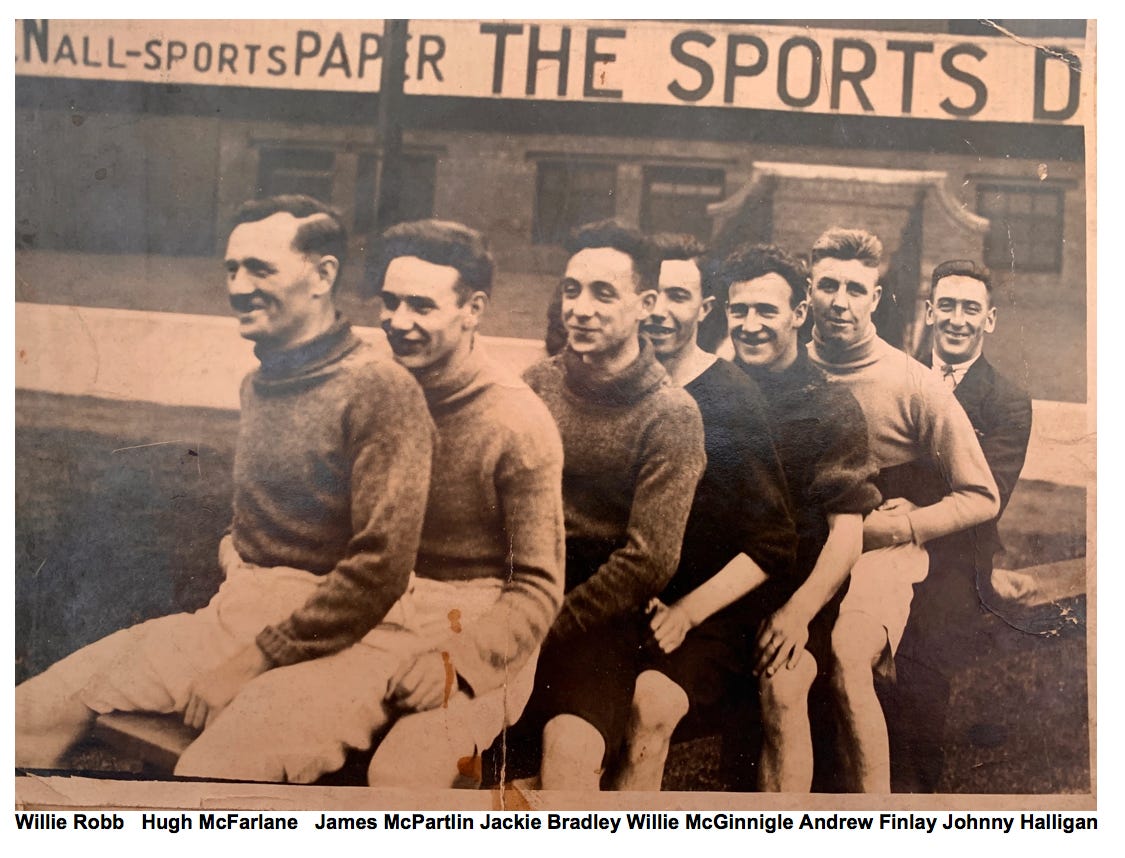
James played as a winger or inside forward, and in those positions were Jimmy McColl, who had a lifelong Hibs connection and is sixth in the all time scoring charts, Johnny Halligan, who is tenth for appearances and Jimmy Dunn, who was a Wembley Wizard. Additionally, on the wing, James’ favoured position, was Jackie Bradley, who arrived at the same time, scored eleven goals in thirty seven appearances in his first season, and eleven in thirty the following season.

James persevered though, and in 1927-28, played in six league games, including against Rangers at Ibrox, and made a number of reserve team starts, netting against Hearts at Easter Road, placing him sixteenth for appearances that year – a squad player as we would recognise today.

Come the end of the season, to the surprise of the support, Hibs decided to release James, who may have been conflicted between leaving his beloved Hibs and moving to get some more game time.

Despite rumours that Third Lanark wanted him, it was Hibs’ cup opponents this week, Ayr Utd, who came in for James’s signature to take him to Somerset Park for the 1928-29 season, in front of their new stand, which I look forward to occupying on Friday evening.

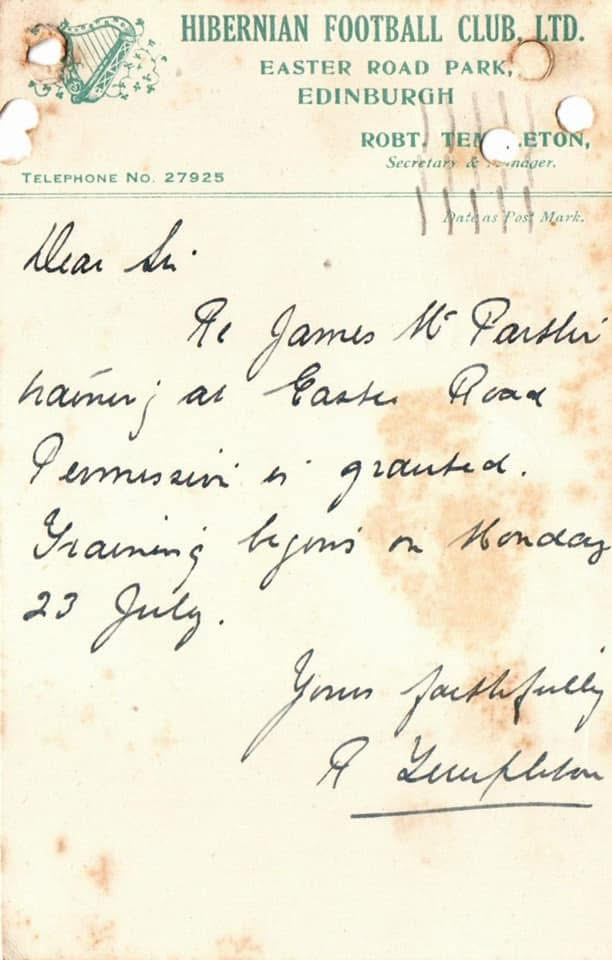
I had long wondered about the journey through to Ayr and whether James stayed in lodgings, until, a few years ago, the Ayr Utd archivist dug out a postcard, signed by Hibs manager, Bobby Templeton, giving James permission to train with Hibs at Easter Rd rather than travelling through every day.

Maybe this betrayed a diminished commitment from James, or maybe his mind was turning towards his eventual career away from football, but he failed to make the first team at Somerset Park that season, the newly promoted Honest Men finishing sixteenth, two places behind Hibs.

However, he did play regularly for the reserves, and scored against the Hearts at Tynecastle!

His next move would have been surprising to football fans but probably not to those who knew him best. As mentioned before, he had been brought up with a focus on helping those less well off, or who were vulnerable, and he came to the realisation that he had a vocation to become a priest, and particularly a Franciscan Friar – a religious order dedicated to communal living, with shared possessions and a mission to help the poor and sick.

He studied at a seminary in Buckingham, but was unable to leave his football behind completely. Along with another trainee priest , he turned out for Buckingham Town, who played junior football at Ford Meadow, only a few hundred yards from the college. There was, apparently, a bit of a local league stooshie, when it was discovered they were both former professionals!

During his time with “The Bucks” he was the star player – known as “College Boy” and was a regular scorer, playing in positions across the front line.

Once he was ordained as a Franciscan priest, however, the football stopped, but was never far from his thoughts. He apparently started one sermon in a nearby town: “The last time I was here, I missed a penalty, and went back to Buckingham under a cloud.”

A couple of years ago I visited Buckingham’s ground. The team itself has since migrated to Milton Keynes and performed under various names, and the ground is now owned by the local university – but it was still a thrill – as it is at Easter Rd, and when I go to Somerset Park, to look at the wings and think of James McPartlin surging forward and putting in the crosses, a strong connection with an ever more distant past.

Eventually, he was stationed in Dundee’s Friary at Tullideph. He is still remembered for his kindness and wit and his ability to relate to folk – especially in hospitals, where the staff would often ask him to use his exceptional talents on piano to raise the morale of the patients. He was much loved for his sermons which were thought provoking and laced with humour, and was a welcome visitor in houses across the city.

Luckily, he came often to Edinburgh to watch the Hibs, and I have many memories of him as someone who would make me laugh and interact with me. He had a trick of flicking up an orange over his head and balancing it on the back of his neck, having lost none of his technical skills. Somewhere I have a blackboard on which he was teaching me how to spell before I started school. The words he wrote were Bib, Fib, Nib, and Hib – which he insisted was somebody who played for the Hibs!

When I was not quite four years old, in January 1956, my dad and uncle James took me to my first Hibs game. It was a 2-2 draw against Hearts in front of the last sixty thousand attendance at the Holy Ground. I remember nothing of the game – though I can claim to have “seen” four of the Famous Five playing – but, of course, as any football fan would understand, the thrill remains in having been to see the Hibs with my dad and my uncle James – the only time it would happen.

Sadly, my dad and James would both die within the next three years, unbelievably young, in their fifties, but their memory and their influence lives on. On his death, the papers headlined “Footballing Friar Dies” – he would have liked that.

I always think that uncle James is a great reminder of football’s place in our lives. Of itself, it is “only a game”, an entertainment, something to divert us from the more serious parts of our lives. It can, of course, become too important for some and become an unbalanced influence, but it can also be a release of tension, a bringing together of like-minded folk, and a force for good.

James loved football, but his goal in life was to bring comfort to those who needed it. Like the founders of Hibernian, he was concerned for the poor and vulnerable – not in an attempt overly pious manner, but in a human way which brought faith, music, laughter and optimism into their lives.

And surely that is where football should excel: bringing enjoyment, positivity and comradeship where it is needed; to be a focal point in the community – based on sport, but seeking to provide a sense of meaning and solidarity to its supporters in their day to day lives.

Like my dad, James gave me core values – concern for others, faith, enjoyment of life and an undying love for Hibernian FC. It’s a story repeated amongst supporters around the stadium every time the Hibs play. The club is in our DNA just as surely as our relations and forebears, it brings us continuity, connection and closeness to those who came before us, and hopefully to those who will come after. Our family are now into four generations of Hibs support, covering 138 years.

I inherited little of James’s footballing ability, but I hope I aspire to some of his values.

So, as I sit in that grand old stand at Somerset Park at the Uncle James Derby on Friday night, I’ll be wanting Hibs to win – of course I will, but I’ll also be thinking of uncle James on the wing in front of me, in green or in white – a talented footballer, but a better man.

Giving footballers a good name

Over sixty years and around 1750 matches attended, I’ve gained a fair perspective on football, its changes, and its development. I have never believed that has made me  an “expert” on the game, but it does bring a certain insight into what makes a player truly “great” –  and it’s about far more than goals scored, games won, or trophies achieved.

Wall to wall television coverage has bred generations of football fans for whom “success” is measured in global trophies and top level skills: the razmataz so powerfully  promoted by subscription channels on so many “Super Sundays”.

However, there are other, perhaps more substantial, means of judging the game and its players.

So, as their departure from the club is announced,  when I see the word “icon” used in connection with Hibs’ Lewis Stevenson and Paul Hanlon, as an old English teacher, I find myself wanting to examine exactly what that means.

The dictionary tells us that an icon is “a person regarded as a representative symbol or as worthy of veneration”.

So it is someone who stands for something and deserves to be greatly admired.

Well, step forward Paul and Lewie!

Obviously more than a thousand appearances in the green and white between them counts for a lot. The same can be said of their whole hearted efforts for the club, on and off the pitch. I can never remember either of them giving less than 100%, whatever the game or the situation. In appearances, they are up there with other  Hibernian legends such as Gordon Smith, Arthur Duncan, and Pat Stanton, reflecting a similarly long lasting and huge commitment to the Hibs.

But – it’s far more than that for these two much loved members of the 500+ club.

In the eras of the Famous Five and Turnbull’s Tornadoes most footballers led lives not too dissimilar to the supporters, many of whom they knew as family, neighbours or acquaintances. The twentieth first century has seen money,  media and globalisation change the nature of the game. Agents shuttle footballers around like cash-producing chess pieces on a giant marketing board, players are encouraged to have an eye for the main chance, branding opportunities are not to be missed, they lead their lives in a celebrity bubble. Becoming “rich and famous” is as likely as a “love of the game” to propel youngsters towards professional football.

This is not a paeon to “the good old days” – society gets the sport it desires, or deserves, and most sports reflect the world in which they operate, so it’s pointless to complain.

Therefore, when we find examples of individuals who appear to be driven by other motives, we are bound to take notice, despite their desire to avoid the spotlight.

It is important not to be intrusive, but, after nearly two decades,  we can certainly make observations about the style and motivation of Paul and Lewie.

Clearly, at each step in their career, they have made decisions not solely ruled by financial considerations. There’s little doubt that two or three judicious moves during their long careers would have swollen their bank balances, but, typically, they stayed with Hibs, and even the  gains made from well supported testimonials found their way into the Hanlon Stevenson Foundation to help those less fortunate than themselves.

These choices were the measures of the men.

In a profession where fame and fortune can lead to fatal distraction, they have kept their eyes on those things which really matter. They know that Bill Shankly was not serious when he made the oft-quoted suggestion that football was more important than life or death. They have remained solidly connected to roots, background, and family. They have a sound awareness of who they are and where they come from – and that knowledge provides a strong foundation for their future progress. Their achievements are facilitated by  the rock solid support of their partners and families, who have made their own massive contributions to Hibernian through the years.

You will find no tabloid exclusives or internet rumours about Hanlon and Stevenson. This is bad news for those who seek “hits” with sound bites,  or like to appear “in the know”, but for nearly twenty years it has been good news for Hibernian Football Club.

In their manner and behaviour, on and off the pitch, personally and professionally, they have shown beyond doubt that, in every element of their lives, the club matters to them, their teammates matter to them, the supporters matter to them, and their careers matter to them. They have demonstrated this motivation, season after season, in their whole approach to being professional footballers.

They have acted in the continuous knowledge that they are ambassadors for Hibernian FC and have a responsibility to behave in a manner which is both appropriate but also respectful to the club’s long history and values.

This is no easy option, physically or mentally.

Some fans will proudly state: “I don’t care what he does off the pitch, he’s a player, not a role model.” They  often view players as simplistic binary cartoon figures: hard or soft, winners or losers, determined or disinterested, inspiring or insipid. This, of course, is nonsense. As human beings, like all of us, players are a complex mixture of psychological and personal traits, and their various strengths and weaknesses will be demonstrated in many ways on and off  a football pitch.

Physically, you do not play five or six hundred games at a high level without being consistently fit and committed to a severe training routine and lifestyle. Mentally, to deal with injuries, losses of form, supporter or coach disapproval, and the vagaries of every day family life,  you need to be psychologically very tough indeed – without necessarily portraying that strength publicly.

There is nothing accidental about Paul and Lewie’s long tenure at Hibs. It is the result of extremely hard work, self knowledge, peak physical fitness, mental fortitude, and the love and support of those to whom they are closest. They will play down all that effort, because that’s the way they are, but they are also driven by a pride in their achievements, and gratitude towards all who have made it possible. Make no mistake, these two are strong characters, as they have shown in deeds rather than words.

Football fans have always had differing motivations. Some support the team in expectation of  regular success, despite its statistical improbability, and believe the club “owes them” for being supporters, and “lets them down” when it loses or plays badly. I can’t subscribe to that approach. I support Hibs because they are Hibs and have been part of my family for one hundred and forty years. Of course, I want them to win, and be successful, and play exciting football, but my support will never be conditional on any of those things. Most of all, I want them to be a club of which I can be proud – standing for decency, inclusivity, honesty and community values – all things which remain core to the club, irrespective of results or league position.

And that stands for its players and staff as well.

Which, of course, is why I hail Paul and Lewie as Hibernian Icons.  

To return to the definition:  “persons regarded as  representative symbols or as worthy of veneration”.

These two players are “representative symbols” of all that is best about Hibs, and they are “worthy of veneration”  for the manner in which they have championed decent values, personal integrity, and care for those around them, while being highly successful and committed footballers: an accomplishment which we all know is a far from universal trait of the game.

To the dictionary definition of “icon”, I would add some Hibs’ flavour.

There are a number of Hibernian players whose names are frequently referenced by supporters who never saw them play, and, indeed, may have been born decades after the players’ lifetimes:  Whelaghan, Groves, Atherton, Halligan, McColl, Smith, Turnbull, Reilly, Johnstone, Ormond, Baker, Stanton, Sir David, and more. These players are “immortal”, in as much as they will be mentioned for evermore; they are as much a part of the club structure as the East Stand or the tunnel.

Now, deservedly, to these names will be added Hanlon and Stevenson: two good men and good footballers, who gave their all to Hibs, made us all proud, and have fully justified their status as icons.

Go well, Paul and Lewie, don’t be strangers, we were lucky and honoured  to have you for so long.

You will always be part of the Sunshine on Leith.

Our deepest thanks and admiration to you, and to your families.

What you stand for is what makes Hibernian truly great..

“A hero is not shaped by their titles or trophies, but by their actions and character.”

Given the origins of the word “hero” can be traced to ancient Greece, it is a term which is now increasingly diverse  in its definition, covering all situations from men walking on the moon to the person who surprises you with a much needed cup of coffee.

This is particularly true in the world of sport, where it often seems confused with another vague description: “celebrity”.

But it was not always so  – especially in football, where, back in the sixties, “heroics” were confined to on field performances, and the private lives of players were often “ordinary” to the point of being unremarkable.

So, in our early teens, the footballers we idolised often led lives not dissimilar to our own, but, when they crossed the white line,  all that changed.

When I moved from Edinburgh to Lancashire in the early sixties, despite my family’s long devotion to Hibernian FC, my Saturday afternoon fix was provided by Southport FC in the old Fourth Division. It was excellent timing as the side had its best decade ever after the appointment of Billy Bingham as a tyro manager. A promotion, a championship and a 5th round FA Cup run all followed on, and provided magic memories for this young teenage lad who thus developed a love of  “going to the match” each week.

In the way of the times, there were players who remained with the club for  five years or more, forming close connections with the supporters.

There were many heroes in that team – the playmaking of Alex Russell, the wing play of Ron Smith, resolute defending from Fred Molyneux, Colin Alty’s enthusiastic adaptability, Brian Reeves brave goalkeeping and  Eric Redrobe’s bustling  commitment. They all remain clear in my memories.  However, in an era when “Roy of the Rovers” epitomised the clean cut, affable and admirable football hero, Southport Football Club had Alan Spence.

From Seaham in Co Durham, he had been a youth player at Sunderland, once turning up to play in an evening game against Juventus in school uniform because his headteacher would not let him leave school early! He had international recognition at youth level as well.  Set upon becoming a PE teacher, he moved on to Darlington while studying and then eventually to Southport in 1962.

His arrival, followed by Bingham’s managerial stint, was to harbinger halcyon days for the Haig Avenue club. He scored 108 goals in 254 appearances for Southport, their all time leading scorer, and was one of those players who could be relied upon to come up with a goal when circumstances desperately required it.

However, it was his demeanour as much as his goals which established his hero status. As a part time player in a full time league, he taught PE at a school situated only a couple of hundred yards from the penalty spot at the ground, and was hugely popular with his pupils, as much for his approach to teaching as for his scoring prowess. Understated, committed, and skillful, he was a perfect fit for Bingham’s team, and contributed hugely to their success. He had the personality you would want for a footballing hero – at least back in those days, and comparisons to Roy Race are not entirely fanciful.

Strangely, from an era where television, and even still photography, were remote from football in general, and lower league games in particular, incidents from those days – goals, near misses, crowd reactions – remain sharp and clear in the mind. Maybe because we recall the event itself rather than the picture.

I remember vividly the moment against Stockport County in a second round cup tie during the famous cup run, when Southport, having been 2-0 down, Alan Spence struck in the mud at the Scarisbrick End to put us 3-2 in front. County equalised but Southport won the replay. Spence scored twice again in the 3-2 third round replay victory against Ipswich at Portman Rd, setting up a fourth round tie against second division Cardiff City. This led to perhaps my clearest memory of this goal scoring hero.

The ground was packed with over 14000 supporters and the atmosphere was tense. We were confident in our team but Cardiff were two leagues above us – mind you, so had been Ipswich! The suspense was only heightened by Southport making a barnstorming start to the game, pressuring the Welsh side, and looking anything but underdogs. If we could just get a goal!

Well, who else but Alan Spence would provide it? A shot was spilled by Cardiff keeper Lynn Davies, the ball rebounding out to the edge of the area, where Spence picked it up, shimmied to the side and slotted it past the keeper into the net at the Blowick End. I was stationed about ten yards behind that goal and had to jump up in the crush to see the ball cross the line. When Ron Smith headed an Alex Russell free kick into the same goal minutes later, Southport were well on the way to a fifth round tie in front of 38000 against Hull City at Boothferry Park.

A huge moment for this fourteen year old, carried closely through all the decades since.

What we did not know at the time was that Alan Spence was suffering from flu and had a temperature, but had been determined to play his part.

Of course he had, he was that sort of hero.

He later played for  Oldham and Chester,  continued as a PE teacher, and coached for a time in the Middle East. He retained his connection with Southport FC and was the first to be inducted into their Hall of Fame.

So returning to the original point of what makes a hero.

I guess if you are a decent person, who has talent,  gives of their best,  provides moments of magic for thousands of supporters, and never lets the side down, then you are well on the way to being considered as such.

If instances from your career are carried strongly in the hearts and minds of those who were youngsters at the time, still resonating with excitement six decades later, I think that qualifies you as a hero.

Alan Spence was all that and more.

Go well, Spencey, you really were one of the Golden Boys, we won’t forget you

Diamond Jubilee

There was, I suppose, an unexpectedly sensual atmosphere for me that day: the clump of shoes on timber boards, the low rumble of anticipatory conversation, punctuated by the odd shout of greeting, the smoothness of ancient wood on bench seats, the unusually rough feel of the gold coloured paper, covered in black ink, that made up the programme. Hanging over all was the fug of cigarette and pipe smoke, the scent of grass and mud, of tar and pitch sinking down from the roof, the sawdust of ageing wooden beams and, from somewhere beneath, the aroma of fried onions. The medical ambience of embrocation cut through it all, mingling with the smell of wet woollen scarves, and here and there the machine gun stuttering of a rattle being swung enthusiastically. Burning hot, highly sweetened, tea, in carefully held plastic beakers, helped the heart beat faster.

Sixty years ago today, Saturday November 16th 1963, “You’ll never walk alone” from Gerry and the Pacemakers, was top of the charts;  rather appropriately as it turns out. The week to come would be momentous: on the Friday, the Beatles released their first number one album “With the Beatles”, and President Kennedy was assassinated in Dallas.

Globally influential though those events would prove to be, there was a more personal impact on my own life on that Saturday,

I was the only child of a widow and we had moved from my birthplace, Edinburgh, at the age of six, after my dad’s death, to Southport, in  Lancashire, to be closer to my mother’s family.

Football was in my family, my family supporting Hibernian since their arrival in Scotland in the 1890s, my uncle playing for them in  1928, and my Lancastrian grandad having taken my mother, as an ten year old, in May 1928, to see Dixie Dean score his record breaking 60th goal for Everton against Arsenal at Goodison Park.

Three weeks before my fourth birthday, on January 2nd 1956, my dad and uncle had taken me to Easter Rd to see Hibs draw 2-2 with Hearts in front of 60,800. I remembered the occasion but not much about the game.

Now, in 1963, I was an eleven year old, at primary school near Liverpool, surrounded by football fanatics, but, having no dad, rather cut off from playing it or going to games. There was no way I could travel to Liverpool to join the massive crowds at Anfield or Goodison, and I had no close friends in Southport who regularly attended the football.

However, the local paper covered the fixtures of Southport FC, in the Fourth Division, and their reserve team, in quite some depth. As an avid reader, I pored over all the match reports and, with the cunning of an eleven year old, suggested to my mother that I could go to a reserve game at the team’s Haig Avenue ground, where there would only be a small crowd, to see how I liked it.

After two reserve games, I had decided that I liked the sensation of “being at a game”. There was very little football on television in those days, so, when I stood  with a couple of hundred others, watching a Southport Reserves Lancashire Combination league game against Netherfield and then Rossendale Utd, I had nothing to which I could compare it – I just enjoyed “being at a football match”.

After some negotiation, it was agreed I could attend Haig Avenue on the following Saturday to see a first team game. Once it was established that this would be a first round FA Cup match versus Walsall, the chance of a big attendance meant I should take a seat in the stand, rather than stand on the terracing. It was an accurate suspicion – the crowd of 4768 was the biggest of the season.

And that’s how it started.

Of course, I had no idea I was instigating what would become a lifetime habit. I suppose I was just delighted that, when my pals talked about being at Everton, Liverpool or Manchester United, I could join in with my tales of Southport.

All these decades later, I would still contend that the rush of anticipation that comes with the first sighting of a football ground on match day is hard to beat – big ground or tiny venue, Saturday afternoon, or under the lights, the heart surges as you join the crowd – again, big or small, that is heading towards the same destination.

There were nerves, of course, that first November Saturday. I was only eleven, not particularly confident, and unsure about procedures for entering the ground and  finding a seat. Would everybody be able to see it was my first game? That horrible, paralysing, adolescent misconception that everybody will be looking at you, whatever their actual reasons for being there!

However, that maelstrom of the senses, as mentioned above, combined with a 2-1 Southport victory over their third division opponents, had me hooked.

It would never have occurred to me, that Saturday night, that I had started on a habit which would be lifelong. I don’t remember making a decision, I just assumed that I would go to Haig Avenue whenever Southport were playing. Why would I not? I had found something new that I enjoyed and I was eager to repeat the dose!

It was fortunate in its timing as the team probably had the best decade in its history over the next decade. The following season I progressed to cycling to the  match, joining hundreds of others  of all ages in a Lowry-esque flow to the ground, bikes left leaning against trees in a local cul-de-sac.

 Most of my pals went to Liverpool or Everton – featuring Labone, Temple, Vernon, Colin Harvey and Alex Young, or Manchester United – with Best, Law and Charlton – but I was more than happy with my Southport heroes. I was also quite content going to games on my own – possibly a trait of being an only child, though if I recognised any pals at the game,  I would happily join them.

As any football fan would know, routines and superstitions developed: which streets I would cycle to the game, which tree I left my bike against, favourite scarf, where I stood at the ground. On the way home, a stop at the chip shop for a fish supper and some football banter with the owner. The shop was opposite Red Rum’s stable and even today, when I hear the famous Aintree winner mentioned, I think of fish and chips!

Players stayed longer at clubs in those days and it was easy to have favourites. I started getting supporters coaches to away games. Most of my knowledge of the geography of the north of England comes from those away trips: Stockport, Tranmere, Crewe, Blackburn, Bury, Hull, Chester, Barrow, Oldham, Lincoln and Chesterfield. All these places have many claims to fame, but for me they are football destinations still. For Southport, there was a promotion and a championship in those days and exciting Cup runs. That helped the excitement, of course, and as a youngster, the result at the weekend could colour my mood for the week.

But it was also a time when I first had the sensation of waking up in the morning with my first thought being: “It’s a match day”. Through my youth, middle age, when at work or on holiday, that feeling has persisted, making the day stand out from all the others around  it.

When that old wooden stand from my first game burned down on the night of Boxing Day in 1966, all I could do was to cycle to the ground, stare at the charred remains, and wonder what would happen to my club. Thankfully, given what was to come at Valley Parade, the ground was deserted, but it was an early lesson for me about the possible dangers contained in a football ground which was fast becoming my “happy place”.

The club recovered, to win promotion that season, and I  continued to establish “going to the match” as an integral part of my life.

When I knew  I would be returning to Edinburgh to university when I was eighteen, my feelings, at least in a football sense, were split between thinking how much I would miss watching Southport every week, and excitement at being able to watch Hibs instead.

Once again, my luck held, and I arrived back in Edinburgh in time to watch Turnbull’s Tornadoes and their magic European nights.

In a repetition of my Southport experience, my first years back at Easter Rd entailed establishing new routines and superstitions and largely going to the game alone.

In time, I started to attend with a couple of mates, and, eventually, with my son as well. He seemed to have inherited my love for live football – just as well as he is now a football writer!

When Hibs aren’t playing, we generally groundhop to non-league grounds. Both of us, when on holiday, have a tendency to gravitate towards local stadia! Much to my surprise and delight, he has also fallen in love with Southport FC on our regular visits to games at Haig Ave.

Ten years ago, on the fiftieth anniversary of that first game, Hibs had no fixture, and Southport were at home to Hereford. We went to the game, sitting roughly in the same area of the new stand as I had in the old stand all those years ago. And, as a treat, I got to meet two of my heroes from the sixties – Eric Redrobe and Alex Russell. Hugs were exchanged and I was able to thank them for all the enjoyment they and their team mates had given me as I started out my supporter’s journey.

It was beginning to dawn on me that my decades of going to live football were not just about supporting a team and wanting them to win, but about much more. Of course, I celebrate victories and feel let down by defeats, but, there is still the buzz of having been at the match and all the attendant rituals that accompany the experience. If forced to choose, I would say I prefer cricket to football, and televised football holds a limited attraction. I’m not so much a fan of football as a fan of going to the match.

Whether its Hampden Park for a Cup Final, or Humbug Park, Crossgates, for a Fife non- league derby, the excitement, the interest, the sense of discovery is still there, year after year, alongside a feeling of “being in the right place”.

I’ve attended matches from Washington DC to Hanoi and the Faroes to Berlin; I’ve seen World Cup quarter finals and East of Scotland Cup games; I’ve enjoyed the different stadia, the fans’ routines, the local football  and country cultures, and I just love going to the game.

So tonight I’m celebrating my Diamond Jubilee and thinking of all the games, all the players, all the grounds and all the laughter and tears that have followed me through life and relationships, highs and lows, youth and “advanced” years.

It’s been great!

Hibs Class

Stephen Dunn’s  success in his professional life lay in Human Resources, and all who knew him will tell you that the emphasis was aways on “human”.

He was that rarest of men – a quiet inspiration. No grandstanding for him, nor overblown rhetoric, just an innate understanding of what needed to be done, and a determination to do what was necessary to complete the task – without fuss or drawing attention to himself.

He was a club Director at Hibernian Football. Club for  three different periods.  I got to know him latterly through his passion for the Hibs and its history, in particular working with him on elements of equality, diversity, and  supporters’ rights. I was first impressed by his commitment to doing  the right thing the right way and for the right reasons. Often we use the phrase “Hibs Class” in relation to football, sometimes with tongue in cheek, but in Stephen’s case it was about integrity, and refusing to let people down, acting in a  proper and considerate manner. Allied with that other most Hibernian of phrases “perseverance”,  it was his solid straightforward attitude which made him so inspirational.

His leadership of so many projects in the Hibs Historical Trust was a practical and highly important demonstration of his innovative thinking and ability to get things done. Most recently, he championed and directed the sculptures of The Famous Five which are nearing completion, and it is fitting to think there will now always be a sixth name linked to “our greatest men”.

I often think that the great folk of the past tend to have their memories honoured and preserved by the great folk of today. Stephen’s work in supporting St Patrick’s Branch Supporters’ Club’s  cooperation with  Ballingarry AFC in the hometown of Hibernian’s founder,  Edward Canon Hannan, was pivotal in ensuring the club’s link with the Co Limerick town is fostered and recognised, and that the founder’s birthplace  is  aware of his  influence – in education, as well as church and football, in Scotland’s capital.

Such links, as is the case with many of the Hibs Historical Trust’s projects, are not nurtured casually. They take hard work, detailed planning, and firm commitment to see them through and to preserve them for the club’s supporters of the future. Stephen’s talents were well suited to the task, as was recognised by all involved in visits between Edinburgh and Ballingarry.

However, as I got to know him in the last year or two, I started to discover the range of his various passions and activities, many of which we had in common. He was on the Boards of the Edinburgh Lyceum and the Glasgow Citizens Theatres and worked tirelessly to promote the drama sector in Scottish life, bringing together theatres, performers and administrators. We both had a particular liking for the work of Arthur Miller and discussed, in particular, “Death of a Salesman”, where I appreciated his insights. His musical tastes largely tallied with mine and he was widely read and knowledgeable about  many aspects of music.

But, after Hibs, perhaps his greatest passion was for photography – in which area he had great talent, naturally focussing on people, through portraits. Such was his interest in the medium that he completed a degree in photography in 2020 and taught and encouraged many youngsters in their photographic studies – even bringing groups along to  Under 18 and Development Squad games at the Hibernian Training Centre so they could practise elements of sports photography.

Edinburgh College Photography Department have long acknowledged his work in this area, pointing out his, again practical, efforts to have a digital print space completed, his care, kindness and generosity towards his fellow students, and his passion for the subject. Their tribute to him is entitled “Legend” – a soubriquet at which he would have baulked, but resonates with the reality of the esteem in which he was held by all.

When they wished to record his name in the new Digital Centre to acknowledge his role in its completion, he demurred, asking  that a Jack Lemmon quote, which could well be his  epitaph, be used instead: “No matter how successful you get, always send the elevator back down.”

We discovered one other shared, and rather odd, obsession – and that was with football ground floodlights -especially those of earlier generations. We agreed it was something to do with aesthetic shape and design and  their various idiosyncrasies,  linked to the excitement of games under the lights, and the way the “light in the sky” will lead you to a football ground, even in a strange town.  When groundhopping, I would always make sure to insta the lights to share with Stephen, and I will continue to do so as a happy memory.

Football is becoming increasingly a ruthless, money obsessed, business – a fact that can overwhelm the original pleasures to be had in viewing a purely sporting contest, but there is still room for soul, integrity and joyful commitment.

By coincidence, we will shortly see the floodlights at Easter Rd upgraded, and the ground which installed the  first floodlights in Scotland, from  Edinburgh firm, Miller and Stables, in October 1954, will have lights that shine even brighter.

But none will shine brighter than Stephen Dunn – with his four pylons of Passion, Integrity, Hard work and Humanity.

We’ll keep them burning, Stephen.

There, but for……..

Who would be a football manager?

It’s a fairly tired old cliché, but, for all that, it rarely gets dusted off before the leaves have started falling from the trees.

However, it’s made an early appearance this year, in the sunshine of an Indian Summer.

Take a look at the Scottish Premiership and its twelve managers.

Of the five managers who achieved the success of qualifying for European competition this season: one has already left his club, and the other four, in various ways, could be seen as being under pressure, not popular with the support, or underachieving in comparison to former holders of the post.  And pressure can come from various circumstances. The pressure to always win the league is balanced with the pressure that comes from the need to fight the annual spectre of  relegation – and the fear that this year we won’t manage it.

After only four games, the knives, if not exactly out for managers, are certainly being quietly sharpened in the back shop.

If you look at supporter “wisdom”, you would conclude that they generally support their manager in two situations: if he is maintaining a mid table position in his first season after promotion, or if the fans recognise the grim financial situation at the club and  admire the manager’s skill in grinding out results against better resourced teams.

Currently, there  are probably only four or five managers in our top league who might feel any security at their club and half of them probably face the dilemma of what to do if another club comes after their services.

Why do they do it?

The easy answer is that they are addicted to the adrenaline rush of top level sport, competition, and the opportunity to display their abilities. In all walks of life, the belief that  “I can make a difference” – whatever the optics of a situation – is a driving force. Indeed, in media interviews they will proclaim a “love” for the pressure, the weight of expectation and the chance to face down major challenges day by day. I suspect for many that is true, and for others it is a coping mechanism, an excuse for the turmoil they bring to themselves and their families.

Whatever the answer, they enjoy a prolonged stay in the roller coaster world of professional sport after playing themselves, and most receive a reasonable wage for working in an industry which might be all they have ever known.

In the end, I suppose, managers are really corks bobbing up and down in the unpredictable currents of elite sport. There are many things they can do to achieve success, but equally, unforeseen events, outwith their control, can dictate the  pattern of their career. I suspect those who handle the job most effectively are those who come to terms with that.

But what of  those whose job it is to appoint a manager?

I recently drew up a three part document examining three relevant questions in this situation: What does a club need in a manager; what does a manager need to bring to a club; and what do the supporters want in a manager?

There are obvious points of agreement which hardly need highlighting – success on the pitch, incremental improvement, generating income by developing players, coaching skills and tactical awareness, sound choice of assistants, clear communication – internally and in the media, a genuine commitment to the club’s aims and ethos.

All of  these aspirations would be common to the three sections of opinion, albeit with differently weighted priorities or expectations.

However, perhaps predictably, there are areas where the needs of the Club owners and executives are at odds with the priorities of the supporters.

Fans, in general, like to see a manager who speaks up for the club and players, radiates enthusiasm, is a favourite with the media, and shows a little (but not too much) humour and quirky behaviour. What they would term “a character”.  Unfortunately,  while all these traits are admired while results on the pitch are acceptable, once the lost games pile up, he is often viewed as a “clown”. They seek an animated figure on the touchline – remaining within the dugout during a game is almost seen as a sackable offence – but if he cuts an excitable figure as his team loses, questions are asked about his example to the players and his temperament.

He is urged to give youth a chance and employ innovative tactics – until this leads to a losing streak and he becomes an ignoramus. One of the  great moments in the stands is to hear the Angry Man screaming “Get a sub on!” closely followed by: “Aw no! Not him!”

However, none of this is to criticise the support, who are generally looking for a manager to reflect and equal their love of the club and desire for success at any price. When a managerial vacancy arises, the fan base are invariably split between wanting a safe but “boring” pair of hands and an innovative appointment, laden with risk but hinting at great possibilities. Such is the fascination and unpredictability of sport – which makes it so engaging and exciting.

So where does this leave the owners and executives charged with making an appointment?

In other industries, the way forward would be clear. A restaurant owner has no need to consult diners on the appointment of a new Head Chef, but he can be fairly confident that his skills in haute cuisine will be transferable from his last place of employment.

Those making a football appointment have to be aware of the supporters’ attitudes – varied though they may be – because, ultimately, whether through season tickets, hospitality or sponsorship, they decide the club’s spending power, and, if they start to stay away, the potential on the commercial side can be hit badly.

So the balancing act becomes the need to appoint a manager whom the Board are convinced can be successful, but whom, to some extent, at least, will be welcomed and given the chance to succeed by the support. Football history is littered with tales of fans’ favourites who failed as managers and also with those who achieved a level of success but were never accepted totally by the support.

Squaring this circle is a conundrum which is exacerbated by the fans’ desire for instant success, and the unpredictability of players’ form, injuries, agents’ demands, and progress made at other clubs, especially local rivals.

Of course, recruitment in any sphere is an art.

As a member of a school Senior Leadership Team, I was involved in interviews for over twenty years, often aware that the headteacher  might turn to me for advice on certain occasions.  It would be fair to say that, overall, I probably preferred being interviewee than being interviewer. Like all “test” situations, an interview ultimately only reveals who is good at interviews, which may not always translate into practical impact when in post. Similarly, there are those who are admirably suited to a post who struggle to come across in the interview situation.

But the world of domestic football is small, and there is a high chance that  coaches, players and club officials will have crossed paths with any likely candidates at some stage, or they will have observed them at close quarters, or heard about them through friends  and connections. Such knowledge, added to the advice of trusted members of the football community, can guide the formation of a short leet perhaps, but, ultimately, the interview panel have to find the right questions and experience their own gut feelings before they make the decision.

Because of the number of imponderables in sport, there can never be a guarantee of choosing the right candidate. Are skills transferable, will the new man settle, will his style, method and personality work with the existing squad and staff at the club, how effective is he at selecting transfer targets, persuading them to sign, and getting the best out of them?

You can combine the information you have gleaned from research, analysis, and contacts, with your feelings on meeting and chatting to the candidate and his interview performance and thus limit the chances of making a major error in your appointment.

But you can never be sure – and that’s what makes it such a difficult task. Experienced versus young and ambitious; hail fellow well met, or deep thinking tactician, familiar to the support or out of left field, native or foreign, adventurous or careful?

It depends on the club, its current position, and its potential.

As with all sport, we can never know – and it is that not knowing which makes it so fascinating.

Football fans, while maintaining their ambitions for the club, would do well to remember appointing a new manager is not simple and it is not an exact science – indeed, it is hardly a science at all.

Which is why those making the choice need something considerably less fragile than crystal balls…………….

Faith, Hope and Charity

In “Fever Pitch”, Nick Hornby wrote that fans are often remembered by chance acquaintances solely because of the football team they supported. However, sometimes, it can be the other way round. There must be a great number of people in various walks of life, who, when they hear the name “Frank Dougan”, think of Hibernian FC.

The soubriquet “Mr Hibs” might be appropriate to Frank, but he was so much more than that, though he would probably be happy with that title, such was his love for the club.

The Hibernian support is, thankfully, diverse and tolerant, and contains many traditional strands. Frank’s particular strand was from an Irish background, through Scotus Academy to St Mary’s, Star of the Sea in Leith and, of course, St Patrick’s in the Cowgate. Nobody would ever doubt Frank’s commitment to his religion, but it was the Christian strengths of hope and charity by which he actually lived his life.

“Hope”, of course, comes as a necessity for a Hibee, and whilst Frank could be brutally realistic about a performance or an individual, he was always sure that better days were ahead – and encouraged many to “keep the faith” in that manner.

However, whereas “charity” is a virtue much praised and encouraged, it takes a special kind of character to practice it in a meaningful and effective manner, and, if I had only one line to describe Frank Dougan, it would be “He was a charitable man”.

He turned the cliché: “He would do anything for anybody” into a raison d’etre.

You would meet him coming out of an away game with someone by his side: “I give him a lift, he wouldn’t get here otherwise”, while the companion would be saying; “When he starts on his stories, I just switch off my hearing aid.”

He was once in front of me at Mass at St Pat’s on St Patrick’s Day – and clearly was not well himself, but had promised to bring someone to the feast day service and was not about to let him down.

Early retirement from a career in telecommunications merely freed up his time for more charitable works, fundraising, helping folk in big and small ways, being someone who could be relied upon to solve problems, support others, and ease the way for those who were struggling.

However, football was his major interest and he had an encyclopaedic knowledge of the game. He was also a leading member of the Tartan Army, through thick and thin, and as well  known to those in Scotland tops and kilts as he was to the Hibs support.

But, of course, alongside family, Hibs were his lifelong love and so many of his good works were performed for the Hibernian Family.

For years, he attended the funerals of Hibs supporters, a representative from the Club whose presence comforted their families and demonstrated the link between club and support. As fan representative on the Board, but outside of those duties as well, he would make it a point to attend these funerals, to speak to those left behind and see if there was anything the club could do to help ease their pain. Hundreds of families will speak of their delight at seeing a club who meant so much to their loved one being represented at the service.

In the joy at finally witnessing a Hibs Cup win in 2016, it was typical that Frank would think of those less fortunate who might be housebound, incapacitated or seriously ill and he visited countless fans, taking the Cup with him, helping them to be part of the celebrations despite their own dire circumstances – a role which must have weighed heavily on his emotions at times.

Those who brought the Cup home to Leith on that sunny Sunday afternoon will forever be club legends, but, in the greater scheme of things, perhaps no club servant more deserved to be on that open top bus than Frank, for all he had given to club and support through the years.

Particularly in his middle years, Frank was a big man in every way – physically, emotionally and in character. Whether in a function room, boardroom or football stadium, you would always know if “Big Frank” was there – and even those who did not know him would be aware of his presence and of his role in the Hibernian Supporters Association, Hands off Hibs, and fan representation. This was in stark contrast to the many kindnesses he practised which were done quietly and without fanfare, just as his looming presence belied his quiet and thoughtful intentions.

I remember bumping into him in the Union Berlin stadium when Hibs were on a pre-season tour, and having a chat as naturally as if we were at Fir Park or  Tannadice. He featured in the Evening News when he accompanied the Hibs to Tobago on another overseas tour. Pictured in a large and colourful Carribean shirt, a caption competition was inaugurated, resulting in the winning entry: “Could you get off the beach, Frank, the tide’s waiting to come in!”

Importantly, though, Frank could never be described as sanctimonious. He helped people because he thought it was the right thing to do and because he wanted to do it. It was natural to him – for which credit to his parents and family. But he could be devastating with his criticisms if he felt folk at the club were making decisions which were not good for the Hibs. He could be as forthright as any fan, but always balanced the criticisms with thoughtful advice.

He had a particular interest in youth development at the club, and served on the Academy Board for some years, where his suggestions would always be constructive and always made with the progress of the club, and the young players, at heart.

When the development squad played games at the Oriam, Frank would be there organising the collection towards Academy funds.

Even during his final years of ill health, he would seldom miss an under 18  development fixture at the Hibernian Training Centre – his brother, Maurice, the volunteer photographer, bringing  a chair for Frank to use on the sidelines, and Frank would hold court, no matter how bleak the conditions, answering questions for supporters and parents alike, throwing comments towards the players, like a parent feeding its young, delighted to be watching the future of the club. The players frequently told me how much they appreciated his presence, but were not beyond giving back as much as they got – while Frank enjoyed the banter.

One of Frank’s many idiosyncrasies was his dislike of flying, which meant that, wherever Hibs were playing: Ireland, Berlin, Scandinavia, the Highlands, or down in England, he could usually find a way to drive there. For those of us who attend each away match, it will seem strange and a little sad to no longer be overtaken at some stage on the road home by that distinctive FD numberplate. How many Saturday nights have I muttered: “There goes Frank.”?

One of Frank’s many Hibs passions was for the Hibernian Historical Trust, because a club which has existed for  nearly 150 years has established a history which provides  a perspective which is far beyond the number of trophies won or successful seasons.

Frank understood that the true worth of Hibs was its place in the lives of countless families, in Edinburgh and beyond, who, through the decades, have declared themselves to be Hibernian supporters, or players, or workers,  and are identified as such. The club is a repository not just of its own history, but of the lives of hundreds of thousands down the years – their hopes, dreams, loves, and struggles – it is a precious history and one which needs careful and affectionate curation, and Frank’s place in that history is assured, and valued by all who knew him and benefitted from his  many kindnesses.

In these times, it is, perhaps, difficult to claim that football clubs have a soul. Global, corporate, and marketing concerns can overwhelm that simple connection between supporter and player, the memories of games attended with parents or children, the passing on of that illogical love for such an unpredictable institution.

But, if Hibernian still possesses a soul, and I believe it does, then people with the values, commitment, and kindness of Frank Dougan, are responsible for keeping that unique flame burning.

Frank was a lovely man, a great Hibee, and a friend to so many.

Thank you, Frank – keep the faith.

They pass, they pass, they pass, they pass

The streets of Edinburgh

Hold half the world for me

In scores, in droves, the living, and the ghosts

The streets of Edinburgh

Mean most to me

                                   The Proclaimers.

On being the best version of yourself

Ron Gordon, the Chairman and majority shareholder of Hibernian FC, was a highly successful entrepreneur. However, a brief look at his business  history suggests that, ultimately, he was a communicator – someone who reached out to others, especially those most in need – through technology, media, or community finance. He possessed communication skills far beyond the mere transmission of a message.

The first time I met him was at the Hibernian Training Centre, shortly after he took over the club. He was preparing to go out and watch the players training and struggling to get into some appropriate gear. He may have been prepared for the exigencies of the Scottish climate, but possibly less so for the micro climate that whirls around East Mains.

He grinned across at me: “If I had known I was going out on grass, I would have brought my golf shoes!”

It was, I was to learn, a typically understated moment . No sign of “Do you know who I am?” “Who are you?” or formal introductions – just a self deprecating comment to a colleague. He was easy to like and easy to respect.

For a number of reasons, I find myself at Easter Rd on match day a good hour or so before kick off and I leave a couple of hours after the final whistle. The car park in front of the West Stand, especially over an extended period, provides  a fascinating viewpoint on the matchday experience.

There is the colourful and diverse parade of supporters arriving from all quarters – young and old, families, friends and solos, the excited first timers and  the long time fans. You realise that, for many, this is a weekly ritual stretching back decades, it is the time and place where they can summon up childhood memories, and recall those they have loved who used to walk beside them.

Into this celebration and anticipation would come Ron and his family, often unnoticed – just a family saloon, no security or special arrangements. Often, when they left the car, they would be recognised, and again it was noticeable that supporters felt able to approach them, to chat, or ask for selfies. There were no brief fixed smiles here but genuine interaction, an interest in who they were, where from, how long they had been supporting Hibs. Questions about the team would be answered, fans concerns understood and noted. Another example of that ability to reach out and communicate.

Back in July, Ron crossed paths with Martin Boyle in the car park, and they paused for a chat. At this stage there was no public suggestion that Martin might re-sign with Hibs, and this was not an attempt to hijack him, but rather a conversation built on genuine concern and a mutual respect; a “good to see you, how have you been?” moment. As a supporter, to see that level of affection between the Chairman and a former player, was very affirming.

After the match, the fans disperse pretty quickly, leaving only the Hospitality clients to exit at different stages, the club gear to be loaded into the van, and, eventually, the press to finish off their post match business.

At some point during this period, Ron and family would emerge into the small group of supporters who wait around Reception hoping to see a player or two. There would be that same warmth of reaction between fans and the family, perhaps Kit chatting to a player’s wife or a  player’s child running up to Ron for attention. Children are often the best judges of character.

I could not claim to know Ron after a handful of brief encounters, but it was not difficult to detect his leadership and its style around the club in general.

The streaming of his funeral service from Arlington, Virginia, gave us an opportunity to discover something of his life away from Hibs.

On this side of the Atlantic, I guess most people would see Arlington as a part of Washington DC, in whose conurbation it sits. That’s a fair suggestion, but not entirely accurate. Washington is an impressive city, with its wide boulevards, French designed federal buildings, and the unmistakable whiff of political power. There are addresses in DC, from Georgetown to  Observatory Circle which denote power, wealth, and a desire to impress. However, given the American political system, a major population change occurs in the “District” every four or eight years, as presidential appointments are made down to all levels of political employment. There is, therefore, a sense of impermanence, of jockeying for position and agenda.

Cross the Potomac River to  Arlington, and wealth will still be a major factor, but choosing to live here speaks of a desire for community, homes before “addresses”, and access to a quieter life than the 24/7 brouhaha of the Capital. Not surprising then that Ron should choose to live here and communicate that understated style of quiet impact without major fuss.

This theme was echoed rather touchingly in his funeral service, where we were told that, though his golf had scarcely improved over twenty years of playing, he would finish each round saying: “I think I’m getting better!” Never boastful, always optimistic!

His sons presented a loving picture of their family life, and Colin remembered Ron urging him to run for his school’s student government body when only just into his teenage years. He was a little daunted, but with his dad running what Colin smilingly referred to as a “proxy campaign”, he managed to win.

Their winning campaign slogan reflects well Ron Gordon’s legacy at Hibernian FC, one which will endure for as long as his reputation as a communicator and  a kindly and engaged owner: 

“Little guy, big ideas.”!

Thank you, Ron,  for the Sunshine you brought to Leith.

                          PELE, AFTERSHAVE…….. AND LOSING THEIR GEOGRAPHY

The Summer of 1966 was a good time to be 14.

The Beatles had issued “Paperback Writer” amid rumours that their upcoming album “Revolver” was going to be something special – a worthy competitor to the Beach Boys’  ground breaking “Pet Sounds”. If you were brave enough to go to a disco, you might be dancing to the Four Tops’ “Reach out, I’ll be there”, the Stones’ “Paint it Black” or smooching to the Mamas and the Papas’ “California Dreaming” or “Monday, Monday”.

I was just completing  third year at secondary school and starting to feel I was getting the hang of it all, with a good group of friends to help face the following year’s exams.

Though the second world war felt like ancient history to us as teenagers, in reality it was only twenty years previously, and the country was slowly emerging from a post war grey fug of anxiety and reconstruction. Some say the famous “sixties” only really started in 65/66. Television was monochrome and had three channels, but the radio pirates, on ships around the coast, provided all day music for the pop scene.

If it was not the technicolour dream so beloved of current social historians, it was still a positive experience for the young, who had also recently been freed from the spectre of National Service.

Then there was the football.

The game was still very much based on  “going to the match”. Television coverage was minimal and those who never went to a stadium had mostly to rely on newsreel footage to see important moments. Highlights of European ties, alongside live coverage of the Home Internationals and the Cup Final, completed the average viewer’s experience. Newspapers and magazines would provide match reports and the occasional interview piece, but there was nothing remotely similar to the current  wall to wall coverage – even punditry was still in the future.

So there was a strange dichotomy of reaction to the arrival of the World Cup in England. For football fans, it was obviously an exciting development and much anticipated. There would be sixteen teams from four confederations. A number of stadia were upgraded for the finals – Ayresome Park, Middlesborough, Goodison Park in Liverpool, Old Trafford in Manchester, Villa Park in Birmingham, Hillsborough in Sheffield, Roker Park in Sunderland and Wembley and White City in London. Other stadia had upgraded in the hope of being selected and for most fans this was the first sign of stadium modernisation since between the wars.

It is perhaps an indication of scale and influence of the competition that Uruguay v France had to be played at the White City stadium, as Wembley stadium  refused to cancel the greyhound racing on that date!

Commercial activity in advance of the competition was very limited compared to today’s levels. Esso garages offered “World Cup coins” as a promotion, there was merchandise based on the lion mascot, “World Cup Willie”, and the teams had deals with sporting goods companies. However, even in late spring, those who were not football fans would scarcely have noted the imminent  arrival of the football festival.

In fact, the biggest event of note in the lead up to the competition was the theft of the Jules Rimet Trophy, and its discovery under a hedge by a dog called “Pickles”, which, of course, the media loved. In these more cynical times, we might be tempted to regard that as an inspired piece of publicity, back then, in our naivety, we accepted it as a funny story.

It is interesting to note that, even in the mid sixties, though football was a mass spectator attraction, it was by no means universally followed. Indeed, until the arrival of luminaries like Rod Stewart and Elton John, the idea that you could be equally into music and sport was seen as rather odd. Not being hugely gifted at either, I was able to keep a foot in both camps, but few of the lads at my school who played in beat groups were football followers, and the footballers were seldom heavily into music beyond the pop charts.

So, while the football public were eagerly anticipating the World Cup, there were many others who were less interested or even unaware.

As a supporter, I noted a small advert in the magazine “Charles Buchan’s Football Monthly”. Apparently, if you sent a postal order to the FA, you could purchase three tickets for games at a ground of your choice. As far as I recall, I sent off less than two pounds, and by return received tickets for Bulgaria v Brazil, Brazil v Hungary and a quarter final, all at Goodison Park. I do not recall having any choice in which games I would see, but seeing Brazil twice certainly seemed like a good deal!

Given today’s offers and deals, and corporate packages, and Ticketmaster online queues and the like, it seems ridiculously easy, and reflects the fear back then, in some quarters, that the games might not be well supported.

Of the 70 countries who entered the competition, fifteen, plus England as hosts, had qualified for the finals. Four groups, two winners of each in the quarter finals, then semi finals, and the Final. It was very Eurocentred. African countries had not been given a direct qualification entry route and so boycotted it, and there were strong indications that the head of FIFA, England’s Sir Stanley Rous, was less than progressive in his views.

My first game was Brazil v Bulgaria – and well highlighted  the state of the world and football. As a team from “behind the Iron Curtain”, as the Soviet Bloc was known, the Bulgars were an unknown quantity. Like most of the  Bloc, their players had no freedom of movement and their top club sides were largely army or union based and heavily controlled politically. Whilst we were familiar with players from Portugal, Spain, Italy and Germany through European Cup, Cup Winners’ Cup and Inter Cities Fairs Cup competitions, the team who ran out in white with red trim were unfamiliar to most of the 47000 crowd in Goodison Park.

The same could not be said of the boys from Brazil.

Gilmar, Altair, Djalma Santos, Denilson, Jairzinho were all well known to us from their stellar exploits in 1958 and 1962. Then there was Garrincha – an almost freakishly talented winger – and none other than the great Pele.

It does feel like another age. And I suppose it is.

The train to Bank Hall station, then the walk up the hill, along street after street of Liverpool’s terraced houses, the thought of an international game, in the World Cup. When I met my school pal, we wondered what it would be like – it was a completely new experience to both of us. I had very vague memories of my first football match, when I was not yet four, with 63000 packed into Hibs Easter Rd stadium in 1956 for a New Year Derby with Hearts, but this crowd was easily the biggest I had experienced since I started going to football as a teenager.

The atmosphere was good, though, like ourselves, many in the crowd were a little unsure of how to behave, normally being passionate in their support of Everton or Liverpool, or in my case, Southport or Hibs. Watching two teams with whom you had no connection was a little unsettling. This resulted in the slightly unreal ambience of sustained applause whenever there was a passage of good play rather than the chanting with which we would have been familiar. However, there was an undercurrent of support for the great Brazilians and any chance the Bulgarians had of underdog sympathy was rapidly extinguished when it became obvious that they were on a mission to kick the talented south Americans off the pitch.

To be fair, the Brazilians responded with a fair amount of physicality themselves, and the game was hardly a celebration of silky football.

However, I still feel blessed to have been there.

Pele was eventually forced to leave the field after the ongoing brutality against him – but not before we had seen him score with a rocket free kick. He would play no further part in the World Cup and this would be his only competitive appearance in the UK – so history being made. Equally momentous was the second free kick scored by Garrincha: “the little bird”. This legend had been involved in a serious car crash and after surgery  was reputed to have “two left legs”. True or otherwise, he was certainly mesmerising as a winger. In the second half he scored from a free kick which curved round the wall in one direction and then left the keeper in the opposite direction. We were in the perfect position around the half way line to follow its flight and I can still remember my amazement and the roar of the crowd.

A two goal win for Brazil was a good start, though if less dazzled, we may have noted there was more energy and less fluency than we may have expected from the Samba Warriors.

There was also a subtext to the competition in that the press speculated on attendances at the various group games around the country. My impression was that though crowds were good, at this stage there were few sell out gates. The day after the Bulgaria game, the other game in the group, Portugal and Hungary, attracted less than 30000 to Old Trafford. These were times when international travel was very expensive and long before ordinary supporters could follow their teams around the globe. Most countries only had the support of an official party and some ex-pats who happened to be resident in the UK. Local fans had far less knowledge of the various teams than would be available now, and many were uncertain whether they were  interested enough to go to see the games, especially given the novelty of full television coverage. A harbinger of the future perhaps!

However, it was generally expected that Brazil v Hungary, three days later, would be a good game and accordingly there was an improved attendance of over 51 000. The Hungarians had lost 3-1 to Portugal at Old Trafford so the general assumption was that Brazil would  recover from their rather stolid start against Bulgaria and reassert themselves as “champions”.

There were bigger numbers of visiting supporters, Hungary perhaps being more open to letting its citizens travel than Bulgaria, and the colourful Brazilians with drums and flags making their presence felt.

It turned out to be a game which would resonate down through the decades as one of the great contests. The level of play was such that now the Merseyside crowd were moved to find their terracing voices, though admiring applause was perhaps still the overriding atmosphere.

The game got off to a cracking start with a thunderbolt strike from Ferenc Bene after only three minutes. Brazil reacted strongly and were level through Tostao after fourteen minutes. Thereafter the game pulsed to and fro and this energised the crowd. Brazil had probably been seen as favourites and their supporters’ chants of Braaaazeeel were echoed by a section of the crowd – but there was also sympathy for Hungary as apparent underdogs. Despite their Soviet bloc membership, as a nation they were less obscure than Bulgaria and there was still sympathy for them from the brutal Soviet invasion ten years before. The crowd listened to the chants of their supporters and decided to copy them, and soon the cry of what sounded like “Oo Oo Magyars” echoed round Goodison.

I suppose, in retrospect, we were witnessing the handing on of the baton from an ageing Brazil squad. Eventually, Hungary gained the upper hand, and goals from Farkas on 64 minutes and a penalty from Meszoly nine minutes later gave the Hungarians victory.

Of course, Hungary had humbled England 6-3 at Wembley as long ago as 1953, so it was no surprise that they could play a bit, and we left the ground, partly saddened by Brazil’s apparent decline, but enthused by the style and method of the Magyars approach.

I had another reason for interest in Hungary. They were based at the Palace Hotel by the beach in Birkdale, which was about half a mile from my house, and that had caused great interest locally. They had also played a couple of training games against Southport at their Haig Avenue ground.

The Palace was a massive thousand roomed hotel, one of a number built on seafront locations in the mid nineteenth century when Queen Victoria had indicated an interest in a “Summer palace by the sea”, in the hopes that she might grace them with her attendance. She opted for the Isle of Wight, but the Palace went on to have an interesting history hosting the great and the good of fin de siècle society and then becoming  a rest and recreation base for American servicemen during the war, and hosting such luminaries as Errol Flynn, Frank Sinatra, and Clark Gable.

With the insouciance of youth, I decided to cycle down to the hotel to see if I could catch the Hungarians training. I left my bicycle at the end of the long semi circular drive and headed for the front entrance to the hotel. The squad had just finished training on the front lawns and were headed inside the hotel. Autograph hunting was very popular among teenage boys at the time and there was a group of half a dozen, books in hand, standing by the entrance.

There was no attempt by hotel or football officials to move us away, indeed, there were no adults around at all until a coach pulled up and the players emerged from the hotel foyer. They were more than pleased to sign our books.

We were keen to get their autographs, of course, particularly those of Florian Albert and Ferenc Bene, who were the “stars” of the team, and whom we recognised, but, like any fans, we were delighted to get close up to these players and to see people from “behind the Iron Curtain” at first hand.

There are two major memories from the encounter.

The first was the overpowering scent of their after shave, which they all wore. Certainly in my circles, the only familiar aftershave would have been “Old Spice”, much favoured by grandfathers and the older generation, and perhaps the odd cheap Woolworth’s imitation – none of which produced a tolerable scent. These guys smelled wonderful, having obviously taken full advantage of the increased shopping opportunities in the West, and with their smart blazers and slacks, and carefully combed hair, fully lived up to our adolescent image of sportsmen.

Once we had all the signatures and they drove off in the coach, our next surprise, when we checked our autograph books was that they had signed their names using Hungarian Cyrillic script – a relation of Russian script, which made them even more indecipherable than normal signatures, and there was a mad rush to write the names under the scrawls, with much comparing of books and  while we could still remember who had signed in which part of the page.

There is a wonderful innocence about that memory – not just in footballing terms – where you could casually stroll into a team’s World Cup camp and meet the players who were surrounded  by none of today’s chaotic hoopla, but also in a wider sense.

This was the height of the Cold War – East v West, and the rigid control that the Soviet Union exercised over its satellite states. It was only five years since the Berlin Wall had been erected, and, before that, the Cuban Missile Crisis, when the world was on the verge of nuclear war, and yet these players apparently, were completely unguarded, at least as far as we could see. Perhaps their status as international football stars guaranteed them a good life in Hungary so that the authorities were confident they would not seek to “escape to the West”, or perhaps we were just naïve.

Whatever the truth of the situation, it is a memory that not too many children in this century would be able to replicate at a World Cup or any major sporting event.

Now I had just one more game to anticipate. It would be the quarter final, and we had expected it would probably involve Italy and Portugal – a fascinating encounter between attack and defence in their relative styles.

What happened, of course, was that North Korea – “these little men from North Korea” as commentator David Coleman inevitably called them – shocked everyone and won through to face Portugal.

Now if Bulgaria and Hungary were mysterious to football fans in the West, the North Koreans were completely unknown. It was little more than a decade since the Korean War, one of the many “front lines” in the battle between Capitalism and Communism. It had finished with the creation of “two Koreas”, North and South, separated by a “demilitarised zone” – a situation which still pertains today. Whilst South Korea, with American backing, pursued a western style future, its neighbour to the north became shut off, enclosed and invisible to the rest of the world – a much easier achievement before the age of the internet.

The average football fan had no idea what life was like in North Korea – nor what to expect from their football team. The British Foreign Office did not want to give them visas to enter the country, as the UK did not officially recognise the legitimate existence of the “Democratic People’s Republic of Korea”.  FIFA threatened to take the World Cup away from England if the Koreans were not admitted, and so they arrived in the country, and sang patriotic songs on the train all the way up to Middlesborough where they would play their games.

It would be fair to say that the locals in the north east of England were a little non-plussed by the North Korean team with their identical hairstyles and names like Pak Doo-Ik. When they lost 3-0 to the USSR in their opening game, there was  a general nodding of heads and a patronising: “Well, they ran about a lot and were very energetic, but…..”

However, by the time of their next game when they drew 1-1 with the soccer heavyweights of Chile, they were taking on the role of “loveable underdogs”, and the folk of Middlesborough really got behind them. It emerged that the squad had spent the last three years training and living together and clearly the North Korean regime saw successful World Cup participation would be a major propaganda coup for their political system.

In their final game at Ayresome Park, against Italy, local sentiment was firmly behind North Korea, while expecting a classy display from the Italians. Perhaps the busy style of the men from the East was unfamiliar to the more languid Italians but, when reduced to ten men, no substitutes in those days, after Bulgarelli crocked himself making a crude challenge, the Azzurri struggled and that man Pak Doo-Ik struck to give the Koreans an unlikely victory, the press a wonderful underdog story to cover, and a quarter final against Portugal at Goodison Park which  became a focus of media attention, especially after a lacklustre Brazil had been beaten  by Portugal, 3-1 at Goodison, in the final group match.

Still, the football mad Merseysiders were  choosey about which games they would attend, even if it was a World Cup quarter final.  Almost 59000 had turned up to see Portugal beat Brazil for qualification, but just over 40,000 for this tie suggested most folk felt that the immensely talented Portuguese would make short work of the Koreans.

My pal and I had no thought of that. As far as we were concerned, this was as exciting as it came. We had lapped up all the coverage of the mysterious North Koreans, Portugal had megastars like Eusebio, Torres and Simoes, and the school summer holidays had started. The previous Goodison games had been under the lights on a Tuesday and Friday evening, but this was a Saturday afternoon kick off with a different atmosphere. I had also spent the three previous days watching my cricketing heroes, Lancashire, play Somerset at Southport in one of my  annual sporting highlights. I had no idea how blessed I was!

Such was the crowd’s curiosity about the Koreans that there was a sense of everyone standing on tiptoe to get a good look at them as they ran out of the tunnel – as if they might be aliens!

They were smaller than most football sides we watched and with that uniform haircut were difficult to identify, but they were clearly overjoyed to be at this stage of the World Cup, and while the experienced Portuguese looked on phlegmatically, they smiled and waved to the crowd before kick off. This was a surprise to us as we had been assured by the Daily Express and the BBC amongst others that all who lived under the oppression of a Communist regime were dour, miserable folk, inhibited from any shows of emotion.

The Koreans certainly did not match that stereotype as they started the game and they would play with great verve and freedom of expression. The crowd lapped it up and settled down to support the underdogs while appreciating the predicted skills of Portugal.

At fourteen, I had no vast experience of football matches – not more than three years, mostly watching Southport in the Fourth Division, but even then I could appreciate the enormity of what transpired over the next twenty five minutes.

Portugal started steadily at kick off, confidently passing the ball around, threatening the Korean goal, where their keeper, Lee Chang-Myung, seemed a very slight figure to face up to the undoubted barrage to come.

However, the Koreans had not read the script.

Within a minute they had taken the lead with a real screamer from Pak Seung-Zin and their delight was as contagious as Portugal’s shock was palpable. Of course, the crowds were energised by this and chants of Koreeeeaa – Koreeeeaa rang around the stadium. Further drama occurred on 22 minutes, when experienced Portuguese stopper, Pereira, perhaps traumatised by that unlikely  early goal, completely “lost his geography” as David Coleman was wont to say, when coming for a cross, and was stranded in the middle of the penalty box when a deep return ball  from the left was turned in by Lee Dong-Woon.

The roars of the crowd were now edged with excitement – what was happening here?

When Yang Song-Guk dispatched another screamer just three minutes later, it would be fair to say that the crowd noise became a little hysterical. I have heard nothing like it since in a football ground: it was somewhere between laughing and cheering, crying and roaring. Portugal, the mighty artisans of European football, favourites with many to win the tournament, were three down to the men from North Korea after only twenty five minutes. The crowd could hardly believe it and neither could the North Koreans who jumped about and waved to the crowd after the third goal like kids on a school sports day.

We looked at each other. The Portuguese were a great side, with five of the all conquering Benfica side in their line up, but to overcome a three goal deficit? Could even they do that?

Eusebio – the Black Pearl – it seems, was in no doubt that they could.

By half time he had scored a memorable solo goal and stuck away a penalty after Torres had ben fouled.

The chatter was intense over the half time break – could the Koreans hold on? How  fantastic  was that Eusebio? What a game we were witnessing.

With the second half starting, the crowd were nervous. They really wanted North Korea to hold on, but they were also mesmerised by the craft and trickery of Eusebio, well supported by his colleagues. Just as the excitement of the crowd had benefited the Koreans in the first half, so, I suspect, did their nerves transmit on to the pitch in this second half, and in only ten minutes, Eusebio, who else, had scored a fine equaliser.

Nobody in the ground was in any doubt about the result now, and, inevitably, Eusebio gained the lead for Portugal three minutes later with another penalty, his fourth goal of the game.

Augusto added another with a header ten minutes from time and the dream was over for the Koreans who nevertheless celebrated at the final whistle and acknowledged the support of the crowd.

We were breathless and emotional. It had been the sort of experience which probably cemented my love of attending football matches, as live spectacles rather than television events, for the rest of my life.

We talk often of “one man teams” and the ability of a single player to make the difference between defeat and victory.  Ronaldo and Messi would be quoted in the past decade, I suppose, but it is a view that does not usually stand scrutiny. George Best had Law and Charlton beside him, Gordon Smith shone as one of the Famous Five, how much did Jimmy Greaves benefit from John White and Danny Blanchflower? These players were, of course, capable of sudden flashes of magic to produce crucial goals, but it usually takes more than just one star performer to change around a team’s fortunes over the course of a game.

However, there is no doubt that Eusebio did that at Goodison in July 1966. His four goals and a determination not to be beaten, added to his quite unique ability, pulled the Portuguese out of their first half shock. It was a remarkable performance and I remain privileged to have witnessed it.

And so concluded my World Cup experiences in 1966. I would witness other World Cup games, though not in the Finals,  – notably Scotland’s win over Wales at Anfield in 1977, and I was on holiday in France to share in that country’s joy when they won the Cup in 1998, but those three games in 1966 remain central to my football memories, even all these years later.

It is, I suppose a combination of my age at the time, the era in which they took place, and the remarkable luck to attend three games which were each unique for different reasons. It was only recently I realised that I had seen Pele’s only competitive appearance in these islands; the Hungary victory over Brazil is still mentioned  as a classic; and that Portugal win over North Korea is the perfect tale of the possibility of a massive upset overturned by individual brilliance. To see players like Pele, Garrincha, Bene, Albert and Eusebio within the space of  three weeks still seems a little like fantasy.

And so we come to the current World Cup tournament.

Since 1966 there have been fourteen World Cup campaigns. Between my support of Scotland and Ireland, I have had an interest in five or six of them. In others, I have admired the play of France, Belgium, Spain and Holland amongst others, and despite myself, through the years I  have watched far more televised games than I intended, and seldom missed a final. The usual memories pertain: Gemmell’s goal for Scotland, Pat Bonnar’s penalty save for Ireland, the rise and fall of Zidane and so on.

But of this year’s tournament I have watched not a second. 

The ludicrous decision to make Qatar the hosts, the disruption to football seasons around the world, the evident graft involved in the decision, and the appalling human rights record of the host nation all combined to produce a sense that there was not much point to watching football in such a scenario. It had happened before: after a lifetime of being a runner and a big fan of athletics, the behaviour of the  Chinese Government  in the preparations for the Beijing Olympics of 2008, people being made homeless and relocated forcibly to facilitate the building of stadia, combined with rampant substance abuse and manipulation amongst athletes, made it feel like athletics was not worth watching in such a context.

Indeed, in the decades since elite sport went “professional”, that is to say, became the property of global corporations and  oligarchs, and driven by megabucks, it seems to me nigh on impossible to retain any of the childlike naivety  which, for most of my life made it so enjoyable. As fourteen year old, I saw sport as a chance to step aside from the serious concerns of life, to lose myself in watching honest endeavour, or playing to the best of my ability. It was, it seemed to me, part of the best of humanity.

Was it perfect?

Of course not. Even then, the tales of brown envelopes, shamateurism, drugs, and exploitation were current – but were still seen as aberrations rather than the norm.

There was enough honesty to maintain the dream, if you like, to preserve the aspirations to Olympic values and sportsmanship, at least nominally.  We seem to have reached a stage where there is no longer a pretence that major sports events are about anything more than marketing opportunities and broadcasting rights – with the sports men and women operating as commercial assets.

However, perhaps this is the inevitable view of someone who has loved sport for over six decades; maybe older folk cannot be expected to maintain the joyous naivety of their teenage years. We should, perhaps, acknowledge that the world and its attitudes have moved on, and the current state of sport is merely reflecting that.

Whether that is true or not, there is nothing to be done about it, except perhaps to try and ensure there are enough supports in place to react to the emotional stress and mental pressure imposed on the sports people operating in such a milieu, and to manage the fallout.

Not surprisingly, I prefer to look back on the innocence of 1966, before elite sport “lost its geography.”