Uncle James Derby

That famous son of Ayrshire, Bill Shankly, is often misquoted as saying football is more important than life or death. In his retirement, he clarified that he regretted taking that attitude during his career. As a socialist and a humanitarian, Shanks clearly had a wider view of the world. However, in one aspect, he was making sense – for many people, football is an important and central part of their lives, and it produces threads that run through families and their histories.

I am reflecting on that in the lead up to Hibernian’s visit to Somerset Park on Friday in the Scottish Cup. It is a fixture which my son refers to as the “Uncle James Derby” – and I’ll tell you why.

Like many Hibernian families, our history with the club goes back to Ireland and Edinburgh’s Southside. My grandfather and his siblings were born in Co Leitrim in the west of Ireland, my grandmother in the neighbouring Co Roscommon, just a few miles from the birthplace of Hibs’ first captain, Michael Whelaghan. Both came to the Southside via Brooklyn, and set up a grocer’s shop selling Irish produce in Buccleuch St, a street in which they lived at three consecutive addresses at the turn of the twentieth century. In the 1890s, my grandfather and his brother had been “business sponsors” of the Hibernians in their early days.

My dad and his brothers were naturally Hibs supporters, and had grown up kicking a ball about on the Meadows, which was overlooked from the back window of their stair when they lived at 120 Buccleuch St. However, James, my uncle, showed particular ability as a player, which led to family difficulties when he was a teenager in the 1920s. Dispatched with the grocery delivery cart to the big houses on Minto St, he would return via the Meadows, and, if he saw a game in progress, could never resist joining in, the cart pressed into service as goalpost.

When he was younger, he might be lucky in that his mother would spy him from the back window and roar at him to get the cart back to the shop. When the family had later moved across the street, that would require a summons from his father in the shop, which did not bode well.

Another trait he displayed at this time foreshadowed his life after football.

The twenties were hard times for many; there was a soup kitchen established at the entrance to the East Meadows, and it was not unusual to find folk begging in the area. James could never resist distributing the tips he had been given by the folk in the big houses to these poor unfortunates.

However, all his footballing on the Meadows obviously paid off. The local press have consistent reports of James McPartlin starring for Holy Cross Academy, including scoring the winning goal in an Inspector’s Cup Final.

He joined Midlothian League side, Edinburgh Emmet, named after a great Irish patriot. They played their games at Bathgate Park, situated just off the Canongate, at New Street, on the site of a demolished gasworks. The ground was prepared and laid out with ash and cinders by local councillor Baillie Bathgate, who felt a facility for organised sport might keep local youths out of trouble – thus echoing the thoughts of Hibernian founder, Canon Hannon, when agreeing to form a football club at St Patrick’s in 1875.

Emmet reached a good level in Junior football in the 1920s and there are records of crowds as big as 7000 in attendance – with many more getting a free view from the Canongate tenements and the path along the side of the ground leading up from Calton Rd.

James was 18 in 1926 and invited to sign for Hibernian. This brought great joy in a Hibs daft household and to the lad who had learned his skills on the East Meadows.

The 1920s were not the best of times for the Hibees. Despite Cup Final appearances in 1923 and 1924 (losing, of course!), their league placement was generally mid table or below. 3rd being an outlier in 1925, and in 1931 they would be relegated.

However, when James arrived in 1926 the club had just redeveloped all four sides of the ground including building the West Stand which seated nearly five thousand supporters out of a capacity of forty four thousand.

Maybe the club had overstretched themselves financially on infrastructure, because the first team squad when James signed had an average age in the early thirties, and seemed in need of an injection of youth.

However, at the same time, the team included a number of Hibernian icons, who would be difficult to shift for a newly signed teenager.

James played as a winger or inside forward, and in those positions were Jimmy McColl, who had a lifelong Hibs connection and is sixth in the all time scoring charts, Johnny Halligan, who is tenth for appearances and Jimmy Dunn, who was a Wembley Wizard. Additionally, on the wing, James’ favoured position, was Jackie Bradley, who arrived at the same time, scored eleven goals in thirty seven appearances in his first season, and eleven in thirty the following season.
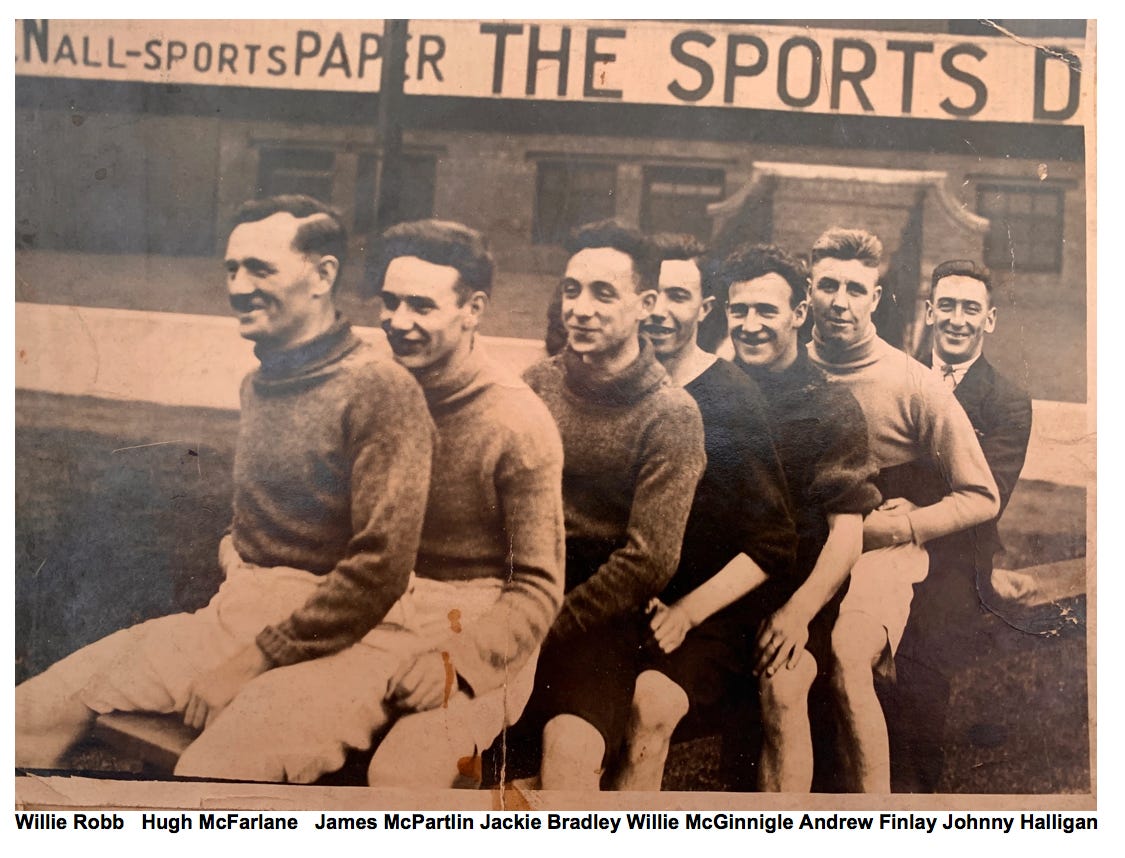
James persevered though, and in 1927-28, played in six league games, including against Rangers at Ibrox, and made a number of reserve team starts, netting against Hearts at Easter Road, placing him sixteenth for appearances that year – a squad player as we would recognise today.

Come the end of the season, to the surprise of the support, Hibs decided to release James, who may have been conflicted between leaving his beloved Hibs and moving to get some more game time.

Despite rumours that Third Lanark wanted him, it was Hibs’ cup opponents this week, Ayr Utd, who came in for James’s signature to take him to Somerset Park for the 1928-29 season, in front of their new stand, which I look forward to occupying on Friday evening.

I had long wondered about the journey through to Ayr and whether James stayed in lodgings, until, a few years ago, the Ayr Utd archivist dug out a postcard, signed by Hibs manager, Bobby Templeton, giving James permission to train with Hibs at Easter Rd rather than travelling through every day.
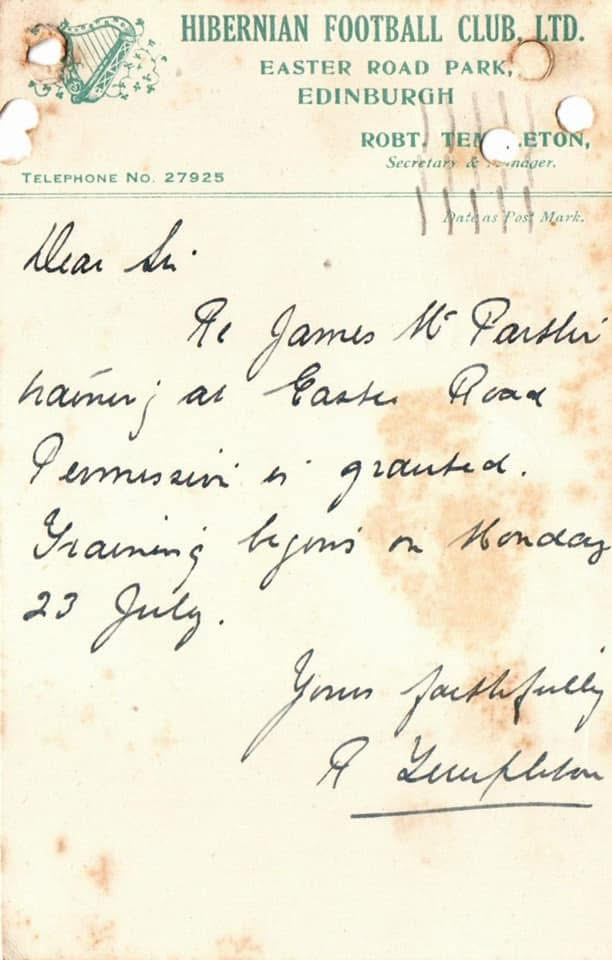
Maybe this betrayed a diminished commitment from James, or maybe his mind was turning towards his eventual career away from football, but he failed to make the first team at Somerset Park that season, the newly promoted Honest Men finishing sixteenth, two places behind Hibs.

However, he did play regularly for the reserves, and scored against the Hearts at Tynecastle!

His next move would have been surprising to football fans but probably not to those who knew him best. As mentioned before, he had been brought up with a focus on helping those less well off, or who were vulnerable, and he came to the realisation that he had a vocation to become a priest, and particularly a Franciscan Friar – a religious order dedicated to communal living, with shared possessions and a mission to help the poor and sick.

He studied at a seminary in Buckingham, but was unable to leave his football behind completely. Along with another trainee priest , he turned out for Buckingham Town, who played junior football at Ford Meadow, only a few hundred yards from the college. There was, apparently, a bit of a local league stooshie, when it was discovered they were both former professionals!

During his time with “The Bucks” he was the star player – known as “College Boy” and was a regular scorer, playing in positions across the front line.

Once he was ordained as a Franciscan priest, however, the football stopped, but was never far from his thoughts. He apparently started one sermon in a nearby town: “The last time I was here, I missed a penalty, and went back to Buckingham under a cloud.”

A couple of years ago I visited Buckingham’s ground. The team itself has since migrated to Milton Keynes and performed under various names, and the ground is now owned by the local university – but it was still a thrill – as it is at Easter Rd, and when I go to Somerset Park, to look at the wings and think of James McPartlin surging forward and putting in the crosses, a strong connection with an ever more distant past.

Eventually, he was stationed in Dundee’s Friary at Tullideph. He is still remembered for his kindness and wit and his ability to relate to folk – especially in hospitals, where the staff would often ask him to use his exceptional talents on piano to raise the morale of the patients. He was much loved for his sermons which were thought provoking and laced with humour, and was a welcome visitor in houses across the city.

Luckily, he came often to Edinburgh to watch the Hibs, and I have many memories of him as someone who would make me laugh and interact with me. He had a trick of flicking up an orange over his head and balancing it on the back of his neck, having lost none of his technical skills. Somewhere I have a blackboard on which he was teaching me how to spell before I started school. The words he wrote were Bib, Fib, Nib, and Hib – which he insisted was somebody who played for the Hibs!

When I was not quite four years old, in January 1956, my dad and uncle James took me to my first Hibs game. It was a 2-2 draw against Hearts in front of the last sixty thousand attendance at the Holy Ground. I remember nothing of the game – though I can claim to have “seen” four of the Famous Five playing – but, of course, as any football fan would understand, the thrill remains in having been to see the Hibs with my dad and my uncle James – the only time it would happen.

Sadly, my dad and James would both die within the next three years, unbelievably young, in their fifties, but their memory and their influence lives on. On his death, the papers headlined “Footballing Friar Dies” – he would have liked that.

I always think that uncle James is a great reminder of football’s place in our lives. Of itself, it is “only a game”, an entertainment, something to divert us from the more serious parts of our lives. It can, of course, become too important for some and become an unbalanced influence, but it can also be a release of tension, a bringing together of like-minded folk, and a force for good.

James loved football, but his goal in life was to bring comfort to those who needed it. Like the founders of Hibernian, he was concerned for the poor and vulnerable – not in an attempt overly pious manner, but in a human way which brought faith, music, laughter and optimism into their lives.

And surely that is where football should excel: bringing enjoyment, positivity and comradeship where it is needed; to be a focal point in the community – based on sport, but seeking to provide a sense of meaning and solidarity to its supporters in their day to day lives.

Like my dad, James gave me core values – concern for others, faith, enjoyment of life and an undying love for Hibernian FC. It’s a story repeated amongst supporters around the stadium every time the Hibs play. The club is in our DNA just as surely as our relations and forebears, it brings us continuity, connection and closeness to those who came before us, and hopefully to those who will come after. Our family are now into four generations of Hibs support, covering 138 years.

I inherited little of James’s footballing ability, but I hope I aspire to some of his values.

So, as I sit in that grand old stand at Somerset Park at the Uncle James Derby on Friday night, I’ll be wanting Hibs to win – of course I will, but I’ll also be thinking of uncle James on the wing in front of me, in green or in white – a talented footballer, but a better man.

Giving footballers a good name

Over sixty years and around 1750 matches attended, I’ve gained a fair perspective on football, its changes, and its development. I have never believed that has made me  an “expert” on the game, but it does bring a certain insight into what makes a player truly “great” –  and it’s about far more than goals scored, games won, or trophies achieved.

Wall to wall television coverage has bred generations of football fans for whom “success” is measured in global trophies and top level skills: the razmataz so powerfully  promoted by subscription channels on so many “Super Sundays”.

However, there are other, perhaps more substantial, means of judging the game and its players.

So, as their departure from the club is announced,  when I see the word “icon” used in connection with Hibs’ Lewis Stevenson and Paul Hanlon, as an old English teacher, I find myself wanting to examine exactly what that means.

The dictionary tells us that an icon is “a person regarded as a representative symbol or as worthy of veneration”.

So it is someone who stands for something and deserves to be greatly admired.

Well, step forward Paul and Lewie!

Obviously more than a thousand appearances in the green and white between them counts for a lot. The same can be said of their whole hearted efforts for the club, on and off the pitch. I can never remember either of them giving less than 100%, whatever the game or the situation. In appearances, they are up there with other  Hibernian legends such as Gordon Smith, Arthur Duncan, and Pat Stanton, reflecting a similarly long lasting and huge commitment to the Hibs.

But – it’s far more than that for these two much loved members of the 500+ club.

In the eras of the Famous Five and Turnbull’s Tornadoes most footballers led lives not too dissimilar to the supporters, many of whom they knew as family, neighbours or acquaintances. The twentieth first century has seen money,  media and globalisation change the nature of the game. Agents shuttle footballers around like cash-producing chess pieces on a giant marketing board, players are encouraged to have an eye for the main chance, branding opportunities are not to be missed, they lead their lives in a celebrity bubble. Becoming “rich and famous” is as likely as a “love of the game” to propel youngsters towards professional football.

This is not a paeon to “the good old days” – society gets the sport it desires, or deserves, and most sports reflect the world in which they operate, so it’s pointless to complain.

Therefore, when we find examples of individuals who appear to be driven by other motives, we are bound to take notice, despite their desire to avoid the spotlight.

It is important not to be intrusive, but, after nearly two decades,  we can certainly make observations about the style and motivation of Paul and Lewie.

Clearly, at each step in their career, they have made decisions not solely ruled by financial considerations. There’s little doubt that two or three judicious moves during their long careers would have swollen their bank balances, but, typically, they stayed with Hibs, and even the  gains made from well supported testimonials found their way into the Hanlon Stevenson Foundation to help those less fortunate than themselves.

These choices were the measures of the men.

In a profession where fame and fortune can lead to fatal distraction, they have kept their eyes on those things which really matter. They know that Bill Shankly was not serious when he made the oft-quoted suggestion that football was more important than life or death. They have remained solidly connected to roots, background, and family. They have a sound awareness of who they are and where they come from – and that knowledge provides a strong foundation for their future progress. Their achievements are facilitated by  the rock solid support of their partners and families, who have made their own massive contributions to Hibernian through the years.

You will find no tabloid exclusives or internet rumours about Hanlon and Stevenson. This is bad news for those who seek “hits” with sound bites,  or like to appear “in the know”, but for nearly twenty years it has been good news for Hibernian Football Club.

In their manner and behaviour, on and off the pitch, personally and professionally, they have shown beyond doubt that, in every element of their lives, the club matters to them, their teammates matter to them, the supporters matter to them, and their careers matter to them. They have demonstrated this motivation, season after season, in their whole approach to being professional footballers.

They have acted in the continuous knowledge that they are ambassadors for Hibernian FC and have a responsibility to behave in a manner which is both appropriate but also respectful to the club’s long history and values.

This is no easy option, physically or mentally.

Some fans will proudly state: “I don’t care what he does off the pitch, he’s a player, not a role model.” They  often view players as simplistic binary cartoon figures: hard or soft, winners or losers, determined or disinterested, inspiring or insipid. This, of course, is nonsense. As human beings, like all of us, players are a complex mixture of psychological and personal traits, and their various strengths and weaknesses will be demonstrated in many ways on and off  a football pitch.

Physically, you do not play five or six hundred games at a high level without being consistently fit and committed to a severe training routine and lifestyle. Mentally, to deal with injuries, losses of form, supporter or coach disapproval, and the vagaries of every day family life,  you need to be psychologically very tough indeed – without necessarily portraying that strength publicly.

There is nothing accidental about Paul and Lewie’s long tenure at Hibs. It is the result of extremely hard work, self knowledge, peak physical fitness, mental fortitude, and the love and support of those to whom they are closest. They will play down all that effort, because that’s the way they are, but they are also driven by a pride in their achievements, and gratitude towards all who have made it possible. Make no mistake, these two are strong characters, as they have shown in deeds rather than words.

Football fans have always had differing motivations. Some support the team in expectation of  regular success, despite its statistical improbability, and believe the club “owes them” for being supporters, and “lets them down” when it loses or plays badly. I can’t subscribe to that approach. I support Hibs because they are Hibs and have been part of my family for one hundred and forty years. Of course, I want them to win, and be successful, and play exciting football, but my support will never be conditional on any of those things. Most of all, I want them to be a club of which I can be proud – standing for decency, inclusivity, honesty and community values – all things which remain core to the club, irrespective of results or league position.

And that stands for its players and staff as well.

Which, of course, is why I hail Paul and Lewie as Hibernian Icons.  

To return to the definition:  “persons regarded as  representative symbols or as worthy of veneration”.

These two players are “representative symbols” of all that is best about Hibs, and they are “worthy of veneration”  for the manner in which they have championed decent values, personal integrity, and care for those around them, while being highly successful and committed footballers: an accomplishment which we all know is a far from universal trait of the game.

To the dictionary definition of “icon”, I would add some Hibs’ flavour.

There are a number of Hibernian players whose names are frequently referenced by supporters who never saw them play, and, indeed, may have been born decades after the players’ lifetimes:  Whelaghan, Groves, Atherton, Halligan, McColl, Smith, Turnbull, Reilly, Johnstone, Ormond, Baker, Stanton, Sir David, and more. These players are “immortal”, in as much as they will be mentioned for evermore; they are as much a part of the club structure as the East Stand or the tunnel.

Now, deservedly, to these names will be added Hanlon and Stevenson: two good men and good footballers, who gave their all to Hibs, made us all proud, and have fully justified their status as icons.

Go well, Paul and Lewie, don’t be strangers, we were lucky and honoured  to have you for so long.

You will always be part of the Sunshine on Leith.

Our deepest thanks and admiration to you, and to your families.

What you stand for is what makes Hibernian truly great..

“A hero is not shaped by their titles or trophies, but by their actions and character.”

Given the origins of the word “hero” can be traced to ancient Greece, it is a term which is now increasingly diverse  in its definition, covering all situations from men walking on the moon to the person who surprises you with a much needed cup of coffee.

This is particularly true in the world of sport, where it often seems confused with another vague description: “celebrity”.

But it was not always so  – especially in football, where, back in the sixties, “heroics” were confined to on field performances, and the private lives of players were often “ordinary” to the point of being unremarkable.

So, in our early teens, the footballers we idolised often led lives not dissimilar to our own, but, when they crossed the white line,  all that changed.

When I moved from Edinburgh to Lancashire in the early sixties, despite my family’s long devotion to Hibernian FC, my Saturday afternoon fix was provided by Southport FC in the old Fourth Division. It was excellent timing as the side had its best decade ever after the appointment of Billy Bingham as a tyro manager. A promotion, a championship and a 5th round FA Cup run all followed on, and provided magic memories for this young teenage lad who thus developed a love of  “going to the match” each week.

In the way of the times, there were players who remained with the club for  five years or more, forming close connections with the supporters.

There were many heroes in that team – the playmaking of Alex Russell, the wing play of Ron Smith, resolute defending from Fred Molyneux, Colin Alty’s enthusiastic adaptability, Brian Reeves brave goalkeeping and  Eric Redrobe’s bustling  commitment. They all remain clear in my memories.  However, in an era when “Roy of the Rovers” epitomised the clean cut, affable and admirable football hero, Southport Football Club had Alan Spence.

From Seaham in Co Durham, he had been a youth player at Sunderland, once turning up to play in an evening game against Juventus in school uniform because his headteacher would not let him leave school early! He had international recognition at youth level as well.  Set upon becoming a PE teacher, he moved on to Darlington while studying and then eventually to Southport in 1962.

His arrival, followed by Bingham’s managerial stint, was to harbinger halcyon days for the Haig Avenue club. He scored 108 goals in 254 appearances for Southport, their all time leading scorer, and was one of those players who could be relied upon to come up with a goal when circumstances desperately required it.

However, it was his demeanour as much as his goals which established his hero status. As a part time player in a full time league, he taught PE at a school situated only a couple of hundred yards from the penalty spot at the ground, and was hugely popular with his pupils, as much for his approach to teaching as for his scoring prowess. Understated, committed, and skillful, he was a perfect fit for Bingham’s team, and contributed hugely to their success. He had the personality you would want for a footballing hero – at least back in those days, and comparisons to Roy Race are not entirely fanciful.

Strangely, from an era where television, and even still photography, were remote from football in general, and lower league games in particular, incidents from those days – goals, near misses, crowd reactions – remain sharp and clear in the mind. Maybe because we recall the event itself rather than the picture.

I remember vividly the moment against Stockport County in a second round cup tie during the famous cup run, when Southport, having been 2-0 down, Alan Spence struck in the mud at the Scarisbrick End to put us 3-2 in front. County equalised but Southport won the replay. Spence scored twice again in the 3-2 third round replay victory against Ipswich at Portman Rd, setting up a fourth round tie against second division Cardiff City. This led to perhaps my clearest memory of this goal scoring hero.

The ground was packed with over 14000 supporters and the atmosphere was tense. We were confident in our team but Cardiff were two leagues above us – mind you, so had been Ipswich! The suspense was only heightened by Southport making a barnstorming start to the game, pressuring the Welsh side, and looking anything but underdogs. If we could just get a goal!

Well, who else but Alan Spence would provide it? A shot was spilled by Cardiff keeper Lynn Davies, the ball rebounding out to the edge of the area, where Spence picked it up, shimmied to the side and slotted it past the keeper into the net at the Blowick End. I was stationed about ten yards behind that goal and had to jump up in the crush to see the ball cross the line. When Ron Smith headed an Alex Russell free kick into the same goal minutes later, Southport were well on the way to a fifth round tie in front of 38000 against Hull City at Boothferry Park.

A huge moment for this fourteen year old, carried closely through all the decades since.

What we did not know at the time was that Alan Spence was suffering from flu and had a temperature, but had been determined to play his part.

Of course he had, he was that sort of hero.

He later played for  Oldham and Chester,  continued as a PE teacher, and coached for a time in the Middle East. He retained his connection with Southport FC and was the first to be inducted into their Hall of Fame.

So returning to the original point of what makes a hero.

I guess if you are a decent person, who has talent,  gives of their best,  provides moments of magic for thousands of supporters, and never lets the side down, then you are well on the way to being considered as such.

If instances from your career are carried strongly in the hearts and minds of those who were youngsters at the time, still resonating with excitement six decades later, I think that qualifies you as a hero.

Alan Spence was all that and more.

Go well, Spencey, you really were one of the Golden Boys, we won’t forget you

So VAR – not so good.

article-2104579-011FEC56000004B0-349_634x400

You’ll remember the scene well.

The sweat on your shirt clings to your back and feels cold and clammy; the school, shoes you promised not to wear are scuffed and muddy. Though you tell yourself you’ll be able to shift the green stains from the knees of your school trousers, you know in your heart your goose is cooked with them as well. Your feet are hot and sweaty and your socks have slipped down under your heels making you feel uncomfortable. Looking around, you see that the lights are coming on in surrounding houses and shining brightly in the gloom. Checking your watch, you realise you are twenty minutes late for the time you said you would be home.

Yep – playing football “down the field” as a lad was great fun, though also fraught with the danger of parental disapproval.

But what’s this?

The ball lies still and forgotten behind one of the goals. Instead of running about daft, making footballer shapes, and generally enjoying the game, there are twenty to thirty boys, all stood still, shouting at each other. Hands are on hips, heads are shaking, fingers are pointing.

In the nearest goal, for some reason, one of the guys is carefully rearranging piles of clothing.

“Coats for goalposts” was one of the staples of our football education, alongside “three and in” and “attack and d”. Whether the ball had passed “between the posts” had long been a source of dispute in the game – after all it was the reason for the introduction of a rope and then a crossbar, and eventually goal nets.

But there are two important things to remember about those games of our childhood. Firstly, nobody ever refused to come back the next day because there were disputes about goals or handballs or tackles – it was accepted that was part of the game. Secondly, there were no spectators nor, despite parents’ best efforts, was there a definitive time by which the game should be finished. Whilst the arguments could become heated, they were seen as part of the game rather than an interruption. There was an acceptance by everyone that “the truth might be out there” but it wasn’t necessarily attainable. Goal mouth scrambles, guys searching for their jackets, goal line clearances, and sometimes even duplicitous keepers, meant that the goalpost coats had a habit of shifting, widening, narrowing or expanding. There were guys more adept at folding and refolding the garments than any mammy down at the local steamie.

But, of course, there is a lot more at stake in today’s professional game – billions of pounds of advertising, contracts, television rights and betting company profits. It was probably inevitable that someone would look at sport in general and decree that leaving results to chance and fortune as well as skill – for many the whole point of sport’s addictive unpredictability – was no longer acceptable.

And, given the age we live in, how better to solve this ‘problem’ than with computer technology?

It’s a display of digital technology at its best – detailed views from many angles and the ability to fast forward or slow mo as necessary. It can be viewed in a remote location and also in the comfort of your own home.

There is much to recommend the new Video Aided Referee (VAR) technology – so we should welcome it as a furthering of global footballs’ progress into modern times.

Well, mebbes aye, mebbes no.

Perhaps we should look at the reasons for its introduction, its application in other sports, and its initial impact on recent tournaments.

There has always been a quarrelsome reaction to those who police the rules in sport. Those who play and watch sport are by their nature competitive. It is important to them that they win and anything they feel that is impeding their chances of victory is going to produce a major reaction from them. Referees have probably been advised to “Get a pair of specs” since opticians  first invented eye glasses.

Perhaps the interesting word there is “feel”, because there is nothing more subjective than a player or supporter’s take  on a piece of play which may or may not have infringed the rules of the game. That’s the reasons all sports have referees, umpires or officials to adjudicate on whether rules are being kept or broken. And to  go back to the childhood games analogy, the need for referees in games with spectators was seen as necessary so that kind of  “pause for discussion’ was eliminated.

However, some games “flow” more than others. Tennis and cricket both “change ends” frequently, for instance, but football is based on more or less continuous play. Part of its visceral excitement is in the instant reaction to a goal, a tackle, or a piece of magic. As we’ve seen in recent tournaments, “halting and rewinding” the play while VAR is consulted interrupts the momentum and can often hand an advantage to one side or the other. The sight of spectators unsure whether or not they can celebrate is graphic evidence of the problem. Sure, we’ve all looked at the linesman after a  goal to check for an offside decision, but that is the act of a moment. Waiting for a “considered decision” can take minutes and kill the moment. It is a construct which fits television needs far more than those of the live audience.

In tennis and cricket, the use of “hawkeye” is far less contentious. The reviews fit into the natural start and stop rhythm of the game and, crucially, they eliminate human judgement – surely the intended result of digital interference in sport. The snick on the bat,  the line of the ball, or the position of the foot or bat – these are all factual and the replayed and frozen pictures confirm position. In tennis, the position of the ball adjacent to the line is also clear.

For this reason, goal line technology – instant and irrefutable – is a comfortable fit for football, but replays of handballs and tackles ultimately come down to the same thing as live action: what does the referee think? Is it worth the interruption to the play to allow a referee a second or third or fourth look at an incident?

Instant reaction is an important part of all sport. In our quest to make it “perfect” and to minimise human frailty, should we now give a striker a second chance to connect with an accurate centre, or a goalie a second chance to collect a fierce shot?

We are now in a position where pundits opine on the referee’s reading of VAR as well as  his original decision. We are no further forward – except the broadcasters have more content to dispute and the bookies have better chances to limit their payouts. Neither of these are crucial or even important to the game as a sport – they are addressing the needs of those who live off the sport.

In a lifetime of watching live football, and other sports, I have accepted that the referee’s decision is final. That’s why hectoring an official and putting pressure on him is such a distasteful element in professional sport. If the ref thinks it’s a goal, if the umpire thinks it’s a wicket – then that’s part of the rules of the game. If they think otherwise, it’s not a goal and not a wicket.

Of course it’s frustrating – for fans as well as players. They may feel financially cheated – fans of their entrance money, players of their win bonus. But we entered into our love for sport fully aware that there would be errors by players and officials – sometimes leading to ridiculous results or monstrous injustices. But that is sport – that is what feeds our passion.

“How did he miss that?” is the cry at every sports ground on a regular basis. If he never missed, what would be the point, where would be the excitement?

And, I’m afraid, that has to apply to officials as well as to players.

We are not robots and we shouldn’t want sport organised as if we were.

Sport is about humanity in all its glorious frailties and unpredictability, as well as its skills and talents – let’s enjoy it for what it is – anger and frustration, joy and relief – in more or less equal portions.

It really does not exist to make rich men richer – or it shouldn’t!

Boxing Day on the A590


I was 17 at  Christmas 1969, with a  holiday job as a postman. Nash was the older brother of a guy I knew at school, and we were  dedicated  supporters of Southport FC. I bumped into him in the bleary early morning of the sorting office, before we went out on our rounds:
“Hey Nash – you going to Barrow on Boxing Day?”

“I might do, aye. You want a lift?”

And so, it seems, are the minor moments upon which  our lives may turn.

If we hadn’t both been doing Post Office student shifts, or had missed each other that morning, the trip to Barrow may never have happened.

It was a  Boxing Day 11am kick off, so Nash arrived in his mini van around 8.00am, with his brother, Peter, sitting sideways in the back. We were celebrating that peculiar Christmas feeling – happy to be at home, but seeking to escape as well. My aunt and her family always visited on Boxing Day, but the early kick off meant I would be home in time to join them, satisfying everyone.

These were heady times for both teams, perennial members of the bottom flight, finding themselves in the unaccustomed heights of the old  Third Division, and, despite the eighty odd miles between us, Barrow, along with Tranmere and Stockport, counted as a “derby” game.

Fifty years ago, roads and infrastructure were more basic than they are now, but most of the journey was fine – dual carriageway  to Preston and then Motorway to Cumbria. However, from the M6 to Barrow on the A590 was basically a winding two track country road.

The conversation was desultory, hampered by the hangover from Christmas  over indulgence. We talked about the prospects for the game, as you do. Neither side was going particularly well, and  we would have settled for a draw.

I was quite drowsy after the early start: there was a fierce and low winter sun which added to the dozy feeling. We were about half an hour outside Barrow when Nash said:
“Bloody Hell, I can’t see a thing!”

The sun had flooded the windscreen completely and he slowed down to a crawl.

The next thing, we stopped. Very suddenly indeed.

I was jerked forward and hit the windscreen. My face was hurting and numb at the same time. Peter was groaning in the back and Nash was shouting:
“I’m paralysed, I can’t move” – till he realised he had put on his seatbelt. Their use was not yet compulsory, but luckily he had chosen to strap in.

We jumped from the car – propelled by some kind of fear that it might catch fire.

Once out in the sunshine, it was obvious what had happened.

The road curved to the right here, but a farm track ran off to the left down a slope. Separating the track and the road was a stone wall, and, driving straight ahead because of  the sun glare, Nash had hit the end of it. Had he not slowed down so much, we may have been in a far worse situation – as was confirmed by the police, who arrived shortly afterwards.

“Aye, well, lads, you’re lucky – couple of guys were killed here last week!”

We checked ourselves out –Peter was bruised from rolling about in the back after the collision,  Nash had a stiff neck and sore ribs. I put my hand to my mouth and realised there was blood, causing me to check my teeth were all still in place. No damage there, thank goodness, though I found myself spitting out bits of splintered windscreen from inside my top lip  where my face had obviously flattened itself against the glass.

I’ve no idea what arrangements were made for the car – it was an obvious write off, with the front embedded in the wall, windscreen shattered – but the cops asked us if we wanted a lift to anywhere.

In what was probably the defining moment in my life as a football supporter, I joined with the others – without hesitation – in saying:
“Holker St football ground please!”

The police duly obliged – no doubt questioning our sanity – and dropped us off outside the ground about fifteen minutes before half time.

By that time we were just delighted to have made the game – oh the priorities of youth – and pleased that the turnstiles were still operating.

We bundled into the ground and on to the terracing, not realising we were surrounded by Barrow supporters. There was a fair amount of aggression involved in following football  in those days, though to be fair, in the lower divisions, it mostly took the form of macho posturing as the support changed ends at half time, so finding ourselves in among the home support was a bit worrying.

However, they seemed strangely quiet at our presence –maybe because they were already leading 1-0 and also, as I came to realise later, because of my appearance.

My gold and black  scarf was covered in blood and my upper lip was heavily swollen, making me look like Plug out of the Bash Street Kids. Alternatively, my appearance may have suggested I had single handedly fought my way into the ground.

Predictably, very little happened for the rest of the game, and we began to wonder how we would get home. Barrow to Southport on Boxing Day was not an easy itinerary.

Possibly still light headed from the crash, I formed a brilliant idea:
“Why not ask for a lift on the team coach?”

The others looked doubtful,  but could think of no alternative, so, after the final whistle, we headed round to the front of the main stand, hoping.

Holker Street in those days, and I suspect now, could never be mistaken for the Etihad. There was a door open to the street and various officials busy with post match tasks.

Suddenly the Southport manager, Don McEvoy, appeared in the corridor. With a boldness born, I guess, out of desperation, I shouted out:

“Hey, Don! Could we hitch a lift back on the team coach, our car crashed and we’re stranded!”

He was hardly nonplussed at all, and motioned us to wait where we were. He may have been preoccupied – given our slide towards relegation and his dismissal, which would come a few weeks later.

Now the disorientation of having been in a car crash was rapidly replaced by the excitement of getting to travel on the team coach!

It would be easy to rewrite history and say it was no big deal – but that would be unfair to our teenaged selves. In those days, supporting Southport meant as much to us as if they were a top division side. Indeed, Best, Law and Charlton were plying their trade an hour’s drive away, but we still chose to watch these Southport guys each week. In addition, the media focus with which we are familiar today was much less intense. What happened “behind the scenes” at a football club was  rarely shared with the public.

Eventually the players came out and we felt the shyness that always pertains when the on field hero becomes the on street person next to you.

We climbed on the coach without  comment  and took our seats. My particular idol, Alex Russell, was sitting in front of me. I wracked my brains for a conversation starter – to no avail. Then he turned round and said:
“Were you lads in a crash?”

It wasn’t the chat you would imagine with your favourite player, but I filled him in on the details.

Most of the journey down the motorway, I sat there thinking:

“I’m on the Southport Team Coach!”

A bit of the mystique of the game was finally broken when I heard the captain, Arthur Peat – a battle hardened veteran,  giving some advice to our young tyro centre back, Chris Dunleavy. It referred to the importance of being able to knee an opposing forward in the back when the referee was unsighted! So much for the beautiful game!

Back in Southport, sadly having driven past nobody we knew, the whole day started to seem like a dream. It was just after 3pm so I was in  time for the family meal and I looked forward to telling them all, or boring them all, about my trip on the team coach.

It was only when my mother opened the door and let out a gasp that I realised I must be looking rather the worse for wear. These days, mobile phones would telegraph such news ahead, but back then, she knew nothing about our adventures.

I had to work quite hard to reassure her I was alright, and then had the presence of mind to go and clean up before I faced the rest of the family – “face” being the operative word.

That was when more glass splinters were spat out and, in the mirror, I finally noted my resemblance to Plug!

It was a day which taught me about the vagaries of fate – though it was some time before I fully took on board its significance.

I had gone to Barrow only after a chance meeting with someone whom  I knew had a car. Had anything more serious happened that day, and 20mph faster and it might well  have, I would have been linked for ever with a couple of guys who weren’t even close pals.  My ending would have come about through a trip to see two obscure football teams in the lower reaches of the leagues, on a Boxing Day morning of sparkling sun and clear blue skies. There would have been no exams, no university, and no career, no partner and no son. Barrow v Southport December 26th 1969 would have meant something much more than a football fixture to everybody who knew me.

The other irony, of course, is that I’m a Hibs supporter  and my family have supported them since 1894. I was living in Southport because my father had died when I was five and my mother had moved there from Edinburgh so she could be closer to family.

However, my thanks to Southport  are due because it was during the ten years I lived in the town, the crucial teenage years,  that I established the routine of “going to the football” every Saturday – a life long habit that has, predictably,  brought  joy and sorrow – but defines part of who I am.

And that day, in retrospect, was the crucial instigator of that passion for live football – when I realised that “watching the lads play” was more important than my own condition or the  tragedy that we had narrowly avoided.

Of course it’s more complicated than that – life always is; but that collision in the Lakes taught me that, just as sometimes you have to treat bad times with humour, equally, on occasion, you have to take seriously some things that aren’t really that serious –  like football.

A good motif for a balanced life.

I am currently Education and Welfare Officer at Hibernian – hopefully giving something back to the club after a lifetime of supporting them – and working with the  development squad youngsters. They know I’m Hibs daft, but also are aware of my affection for Southport FC. One of them set me the question:

“European Cup Final – Hibs v Southport – who do you want to win?”

After some hesitation, I plumped for Hibs, who are, after all, in my blood for generations – but I wouldn’t be devastated if Southport won this game – for, after all, they gave me a lifetime of going to the match.

I still go down to watch “The Port” when Hibs duties allow. The signposts on the road point to  a succession of former league clubs: Workington, Barrow, Southport – as we  drive down the M6, passing the junction for the Lakes and Cumbria.

But whether in Edinburgh or Lancashire, it’s a Saturday  habit happily engrained in me for life, dating, I suspect, from that Boxing Day on the A590.