
That famous son of Ayrshire, Bill Shankly, is often misquoted as saying football is more important than life or death. In his retirement, he clarified that he regretted taking that attitude during his career. As a socialist and a humanitarian, Shanks clearly had a wider view of the world. However, in one aspect, he was making sense – for many people, football is an important and central part of their lives, and it produces threads that run through families and their histories.
I am reflecting on that in the lead up to Hibernian’s visit to Somerset Park on Friday in the Scottish Cup. It is a fixture which my son refers to as the “Uncle James Derby” – and I’ll tell you why.
Like many Hibernian families, our history with the club goes back to Ireland and Edinburgh’s Southside. My grandfather and his siblings were born in Co Leitrim in the west of Ireland, my grandmother in the neighbouring Co Roscommon, just a few miles from the birthplace of Hibs’ first captain, Michael Whelaghan. Both came to the Southside via Brooklyn, and set up a grocer’s shop selling Irish produce in Buccleuch St, a street in which they lived at three consecutive addresses at the turn of the twentieth century. In the 1890s, my grandfather and his brother had been “business sponsors” of the Hibernians in their early days.
My dad and his brothers were naturally Hibs supporters, and had grown up kicking a ball about on the Meadows, which was overlooked from the back window of their stair when they lived at 120 Buccleuch St. However, James, my uncle, showed particular ability as a player, which led to family difficulties when he was a teenager in the 1920s. Dispatched with the grocery delivery cart to the big houses on Minto St, he would return via the Meadows, and, if he saw a game in progress, could never resist joining in, the cart pressed into service as goalpost.
When he was younger, he might be lucky in that his mother would spy him from the back window and roar at him to get the cart back to the shop. When the family had later moved across the street, that would require a summons from his father in the shop, which did not bode well.
Another trait he displayed at this time foreshadowed his life after football.
The twenties were hard times for many; there was a soup kitchen established at the entrance to the East Meadows, and it was not unusual to find folk begging in the area. James could never resist distributing the tips he had been given by the folk in the big houses to these poor unfortunates.
However, all his footballing on the Meadows obviously paid off. The local press have consistent reports of James McPartlin starring for Holy Cross Academy, including scoring the winning goal in an Inspector’s Cup Final.
He joined Midlothian League side, Edinburgh Emmet, named after a great Irish patriot. They played their games at Bathgate Park, situated just off the Canongate, at New Street, on the site of a demolished gasworks. The ground was prepared and laid out with ash and cinders by local councillor Baillie Bathgate, who felt a facility for organised sport might keep local youths out of trouble – thus echoing the thoughts of Hibernian founder, Canon Hannon, when agreeing to form a football club at St Patrick’s in 1875.
Emmet reached a good level in Junior football in the 1920s and there are records of crowds as big as 7000 in attendance – with many more getting a free view from the Canongate tenements and the path along the side of the ground leading up from Calton Rd.
James was 18 in 1926 and invited to sign for Hibernian. This brought great joy in a Hibs daft household and to the lad who had learned his skills on the East Meadows.
The 1920s were not the best of times for the Hibees. Despite Cup Final appearances in 1923 and 1924 (losing, of course!), their league placement was generally mid table or below. 3rd being an outlier in 1925, and in 1931 they would be relegated.
However, when James arrived in 1926 the club had just redeveloped all four sides of the ground including building the West Stand which seated nearly five thousand supporters out of a capacity of forty four thousand.
Maybe the club had overstretched themselves financially on infrastructure, because the first team squad when James signed had an average age in the early thirties, and seemed in need of an injection of youth.
However, at the same time, the team included a number of Hibernian icons, who would be difficult to shift for a newly signed teenager.
James played as a winger or inside forward, and in those positions were Jimmy McColl, who had a lifelong Hibs connection and is sixth in the all time scoring charts, Johnny Halligan, who is tenth for appearances and Jimmy Dunn, who was a Wembley Wizard. Additionally, on the wing, James’ favoured position, was Jackie Bradley, who arrived at the same time, scored eleven goals in thirty seven appearances in his first season, and eleven in thirty the following season.
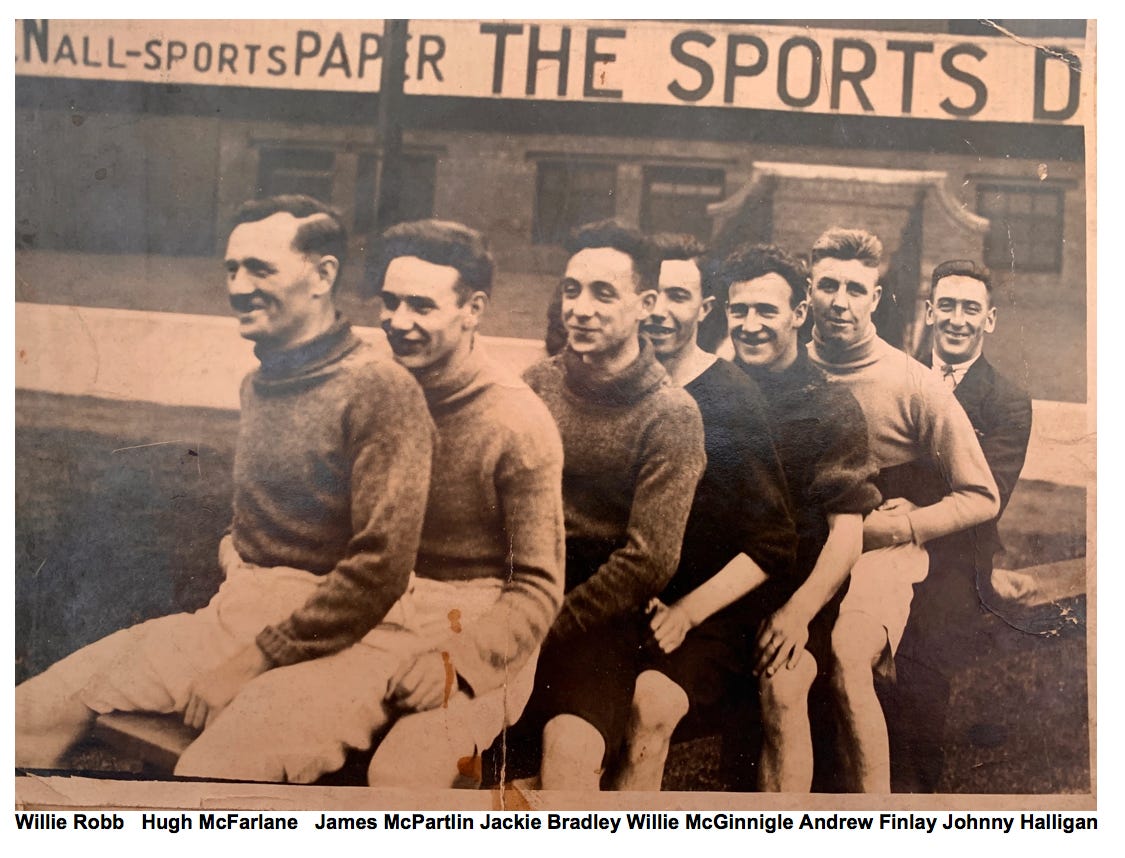
James persevered though, and in 1927-28, played in six league games, including against Rangers at Ibrox, and made a number of reserve team starts, netting against Hearts at Easter Road, placing him sixteenth for appearances that year – a squad player as we would recognise today.
Come the end of the season, to the surprise of the support, Hibs decided to release James, who may have been conflicted between leaving his beloved Hibs and moving to get some more game time.
Despite rumours that Third Lanark wanted him, it was Hibs’ cup opponents this week, Ayr Utd, who came in for James’s signature to take him to Somerset Park for the 1928-29 season, in front of their new stand, which I look forward to occupying on Friday evening.
I had long wondered about the journey through to Ayr and whether James stayed in lodgings, until, a few years ago, the Ayr Utd archivist dug out a postcard, signed by Hibs manager, Bobby Templeton, giving James permission to train with Hibs at Easter Rd rather than travelling through every day.
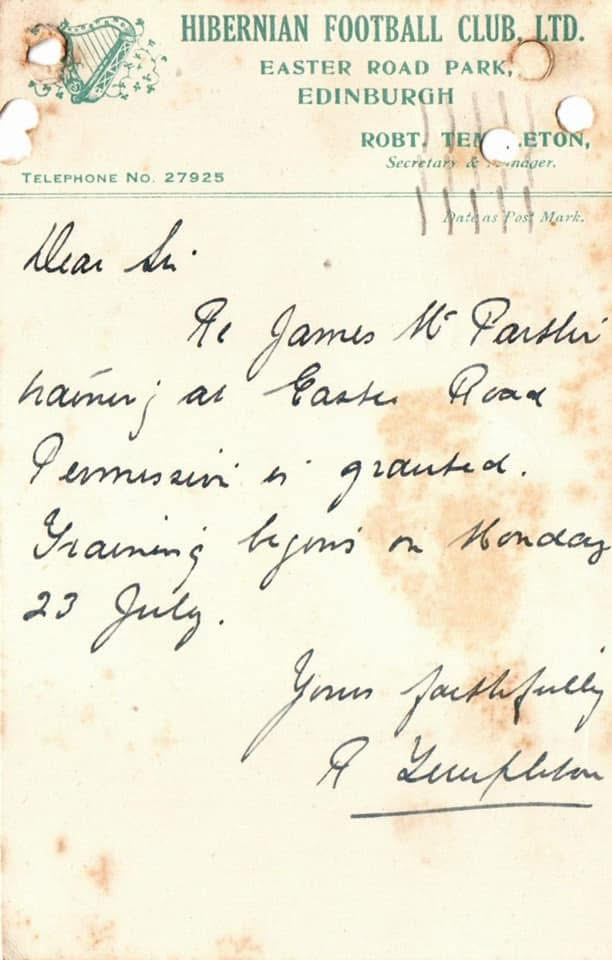
Maybe this betrayed a diminished commitment from James, or maybe his mind was turning towards his eventual career away from football, but he failed to make the first team at Somerset Park that season, the newly promoted Honest Men finishing sixteenth, two places behind Hibs.
However, he did play regularly for the reserves, and scored against the Hearts at Tynecastle!
His next move would have been surprising to football fans but probably not to those who knew him best. As mentioned before, he had been brought up with a focus on helping those less well off, or who were vulnerable, and he came to the realisation that he had a vocation to become a priest, and particularly a Franciscan Friar – a religious order dedicated to communal living, with shared possessions and a mission to help the poor and sick.
He studied at a seminary in Buckingham, but was unable to leave his football behind completely. Along with another trainee priest , he turned out for Buckingham Town, who played junior football at Ford Meadow, only a few hundred yards from the college. There was, apparently, a bit of a local league stooshie, when it was discovered they were both former professionals!
During his time with “The Bucks” he was the star player – known as “College Boy” and was a regular scorer, playing in positions across the front line.
Once he was ordained as a Franciscan priest, however, the football stopped, but was never far from his thoughts. He apparently started one sermon in a nearby town: “The last time I was here, I missed a penalty, and went back to Buckingham under a cloud.”
A couple of years ago I visited Buckingham’s ground. The team itself has since migrated to Milton Keynes and performed under various names, and the ground is now owned by the local university – but it was still a thrill – as it is at Easter Rd, and when I go to Somerset Park, to look at the wings and think of James McPartlin surging forward and putting in the crosses, a strong connection with an ever more distant past.

Eventually, he was stationed in Dundee’s Friary at Tullideph. He is still remembered for his kindness and wit and his ability to relate to folk – especially in hospitals, where the staff would often ask him to use his exceptional talents on piano to raise the morale of the patients. He was much loved for his sermons which were thought provoking and laced with humour, and was a welcome visitor in houses across the city.

Luckily, he came often to Edinburgh to watch the Hibs, and I have many memories of him as someone who would make me laugh and interact with me. He had a trick of flicking up an orange over his head and balancing it on the back of his neck, having lost none of his technical skills. Somewhere I have a blackboard on which he was teaching me how to spell before I started school. The words he wrote were Bib, Fib, Nib, and Hib – which he insisted was somebody who played for the Hibs!
When I was not quite four years old, in January 1956, my dad and uncle James took me to my first Hibs game. It was a 2-2 draw against Hearts in front of the last sixty thousand attendance at the Holy Ground. I remember nothing of the game – though I can claim to have “seen” four of the Famous Five playing – but, of course, as any football fan would understand, the thrill remains in having been to see the Hibs with my dad and my uncle James – the only time it would happen.
Sadly, my dad and James would both die within the next three years, unbelievably young, in their fifties, but their memory and their influence lives on. On his death, the papers headlined “Footballing Friar Dies” – he would have liked that.
I always think that uncle James is a great reminder of football’s place in our lives. Of itself, it is “only a game”, an entertainment, something to divert us from the more serious parts of our lives. It can, of course, become too important for some and become an unbalanced influence, but it can also be a release of tension, a bringing together of like-minded folk, and a force for good.
James loved football, but his goal in life was to bring comfort to those who needed it. Like the founders of Hibernian, he was concerned for the poor and vulnerable – not in an attempt overly pious manner, but in a human way which brought faith, music, laughter and optimism into their lives.
And surely that is where football should excel: bringing enjoyment, positivity and comradeship where it is needed; to be a focal point in the community – based on sport, but seeking to provide a sense of meaning and solidarity to its supporters in their day to day lives.
Like my dad, James gave me core values – concern for others, faith, enjoyment of life and an undying love for Hibernian FC. It’s a story repeated amongst supporters around the stadium every time the Hibs play. The club is in our DNA just as surely as our relations and forebears, it brings us continuity, connection and closeness to those who came before us, and hopefully to those who will come after. Our family are now into four generations of Hibs support, covering 138 years.
I inherited little of James’s footballing ability, but I hope I aspire to some of his values.
So, as I sit in that grand old stand at Somerset Park at the Uncle James Derby on Friday night, I’ll be wanting Hibs to win – of course I will, but I’ll also be thinking of uncle James on the wing in front of me, in green or in white – a talented footballer, but a better man.


 There's a light in the Sky